Memory and time are inextricably linked. Without the presence of time we wouldn’t have the need for memory, and conversely we wouldn’t count the passage of time without our constant, if imperfect, memory. Musical time can be expressed in a number of ways, from structured time signatures to syncopated rhythms to rubato and fermatas that stretch and slow the beat. Musical time can be taken and given, lost and found. In this way, composers infuse music with their own memories as expressed through their manipulation of rhythmic elements that keep, stretch and slow time.
Two composers, Dmitri Shostakovich and Benjamin Britten, demonstrate expressions of memory and time in their compositions as they processed the realities of living in times of war and social upheaval. Dealing with the consequences of war first hand, each composer negotiated anti-war sentiments in differing ways. Shostakovich’s official position within the Soviet Union complicated his compositional honesty, thus his music demonstrates expression through subtext, quotation and a self-deprecating, ironic lens. Britten, a lifelong pacifist, expressed his sentiments through deeply emotional works that often included a commemoration of the past reflecting a personal, moral depth. Two works exemplify each composer’s approach to evoking memory through the manipulation of musical time. Shostakovich’s Piano Trio No. 2 highlights a juxtaposition of harsh rhythmic articulation with a positive tonality that creates an atmosphere of unsettling memories. Meanwhile, Britten’s String Quartet No. 2 takes the listener on a journey of remembrance guided by the musical language of another era.
Memories Best Forgotten
Shostakovich’s Piano Trio No. 2 is haunting not only in its evocation of thin, veiled harmonics through extended techniques, but also in its relationship to time. Composed as a personal remembrance of a dear friend’s passing, the trio also serves as a darker reflection of the composer coming to terms with the horrors of the Second World War.
The first movement introduces a rhythmic quality that permeates the piece. A series of eighth notes outlines the underlying beat of the movement. Time is kept in four groups of two, a repeated rhythmic motive that finds its way into each instrumental part beginning first with detached staccato and moving later on in the movement to a smooth legato. This rhythmic element evokes a heartbeat, gradually getting faster throughout the work. The heartbeat keeps time but also memory as the music both remembers a personal loss while also processing the pain of a lost collective.

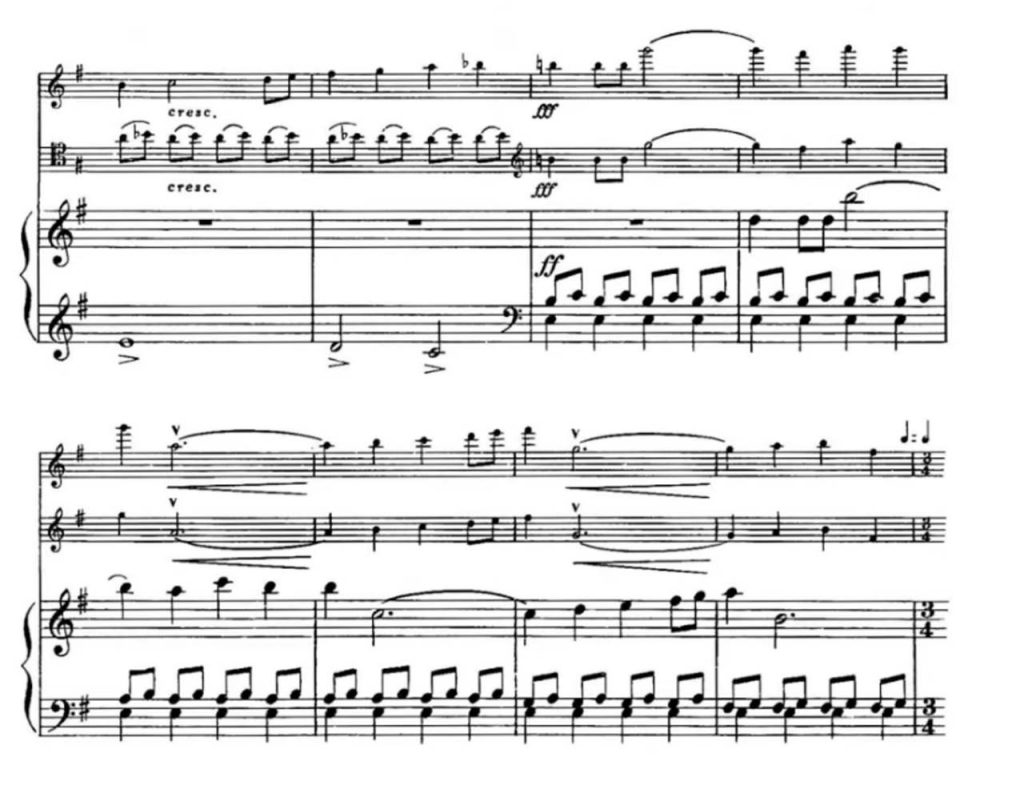
Many have pointed to the work’s second movement, Allegro con brio, as nigh impossible to play at the given tempo. As the movement begins, a pleasant, tonally major melody plays out amongst the trio, at first in an almost cheerful way. However, as the movement develops, the melody becomes distorted, its tonality stripped away as the rhythmic beating of the first movement returns, this time in the sarcastic gestures of repeated eighth notes emphasized by accents and a triple forte dynamic. These running eighth notes appear throughout the work, heightening the feeling of time running out, of events quickly remembered yet not lingered upon. The acceleration of the piece as a whole adds to a heightened sense of anxiety that permeates Shostakovich’s evocations of musical irony. This piece is no exception, with the final movement featuring a macabre dance that propels the piece to its conclusion. Time runs out, barely savored as tensions are left unresolved.

A Tribute to the Past
Written in 1945, Britten’s String Quartet No. 2 was composed to honor the 250th anniversary of the passing of famed English Baroque composer Henry Purcell (1659-1695). In regards to remembrance, this work recalls the past through a personal tribute to Purcell. Memory is recalled through musical techniques and forms that point to the musical language of another era.
The third movement of the quartet, ‘Chacony-sustenuto’, has been discussed as a more overt homage to Purcell. It’s composed of a theme and twenty-one variations with sup-groups separated by ornamented solo cadenzas. This marker of the past reflects the High Baroque style that Purcell was a master of, high dynamic and textural contrast, rich melodic variety and extensive thematic development. The Chacony as a form originated in the Baroque era and consists of a ground bass that outlines the harmony of the work and allows for variation, decoration and melodic invention in the other voices. Britten’s ground bass, however, can be found not only in the final movement and its melodic variations, but also in his use of rhythm to structure musical time.
First introduced by the first violin in the opening movement, a repeated eighth note motive finds its way into the musical texture of each instrument.
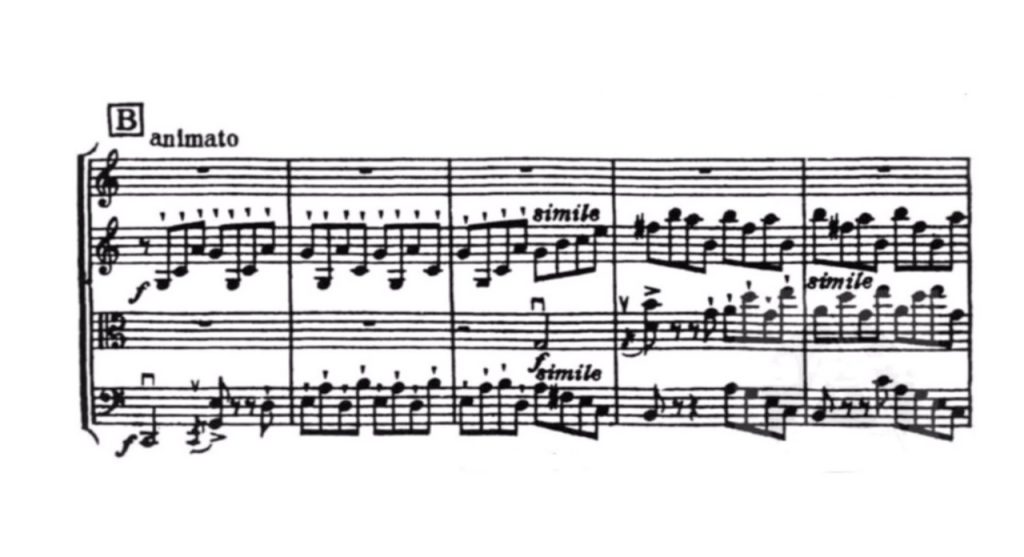
Time is kept by two groups of four eighth notes, highlighting the contrapuntal possibilities of Britten’s harmonic language and calling back to Purcell’s mastery of the technique. This contrapuntal movement is blended with a modernist harmonic language, exploring moments of push and pull between tonalities that accelerates throughout the movement. His tempo marking at the beginning of the movement indicates allegro calmo senza rigore. Quick, calm and without rigor. This last indication in particular constitutes the structure of time within this movement. The movement juxtaposes both rhythmic emphasis through the consistent drive of eighth note motives while also allowing for flexibility. Time is taken in one moment and given back in the next. The movement undulates with energy that sees time as a more flexible fabric, structuring the performance without fully constraining it. This juxtaposition allows for a strong emotional effect to be carried by the flexible passage of time. The unpredictability of interpretation by performers is what gives this movement its intensity.
In the opening of the second movement, further emphasis is given to the time keeping capacities of eighth note motives. The meter shifts from 2/2 in the first movement to a blistering 6/8. Staccatos add to the rhythmic drama within the middle voices as the two outer voices play an aggressive, descending melodic motive. Time is accelerating as the more contemplative ending of the first movement is abandoned for a quick succession of rhythmic ideas that see their climax within the variations of the final movement. The climactic weight of the variations within the tonal flexibility of a modernist musical language blends with the antagonism of Britten’s rhythms to create an emotional fabric that weaves in and out of each movement of the quartet.

Timeless Remembrance
Time structures every musical work we come across. Compositions begin with a rhythm, a marker of quavers and semi-quavers passing stoically along the linearity of our temporal perception. Time signatures place beats into measures, constant or changing depending on the composer’s musical language. A tempo marking at the top of the page structures the time of the piece as the composer accelerates, slows or keeps it. It is within this structure that composers store their memories, preserved in notation and kept alive by performance. Just as our memories play with the perception of time, so does music. Human beings simply can’t experience infinite time scales because we’re such finite creatures. Thus, musical time becomes the reflection of the fleeting quality of human life. Composers infuse their work with memories that end up timeless, etched into text and notes just waiting to be revived by those who have the training to do so. Shostakovich and Britten both play with musical time to give a unique perspective on remembrance as preserved in each work. Some memories are perhaps best forgotten or quickly replayed, as in the case of Shostakovich, while echoes of the past appear as remembrance in the work of Britten. Composers keep time in their music but they also keep their memories, stretching, savoring or rushing past them. Thus, the performance of these works offers a substitute for something that pre-existed. The realization of the composition stands in for an elusive entity made up of a persistent mode of forgetting that is interconnected with our imperfect memories.