
A Fresh and Fun Version of a Classic Story Line
“Nerds” have become the antiheroes of modern society, thanks to their command of tech and ability to process information. It wasn’t always so: long before the Big Bang Theory, the archetype of the socially inept and physically awkward intellectual carried a negative connotation. As early as the 16th century, so-called “bookworms” were deemed elitist and labelled “candle-wasters.” Negative views of the overly brainy, under-athletic, and socially maladjusted persisted over the centuries. The now-common celebration of the “nerd” as an aspirational hero was rare until the onset of the tech boom, beginning in the 1970s.
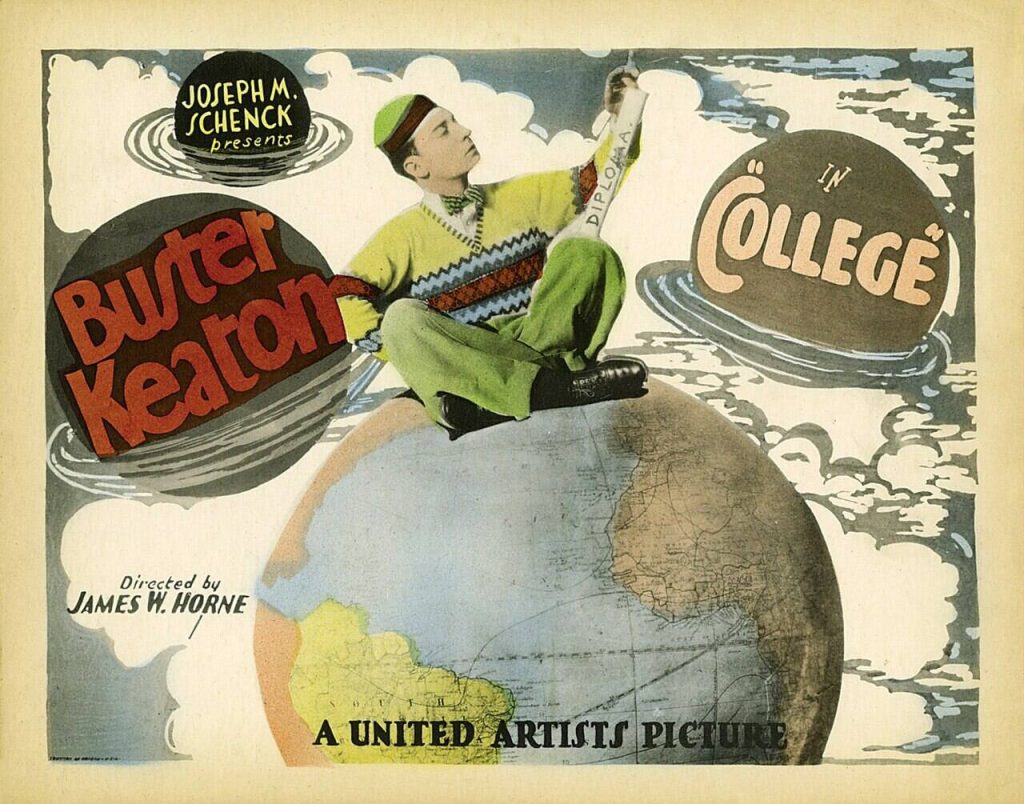
The great film actor-director Buster Keaton (1895–1966) was himself no nerd. Keaton, in fact, was an athlete through and through. His outrageously dangerous stunts demonstrated fearlessness fused with a unique physicality. Keaton staged and performed in scenes that had him swinging and leaping from moving cars, trucks, and trains, enduring terrifying falls, and subjecting himself to life-threatening situations that, along with his genius for story-telling, propelled him to the top in the silent film era. Keaton’s athleticism didn’t deter him from taking on the role of the awkward “nerd” (before such a term existed) for the 1927 comedy-drama, College, directed by James W. Horne with Keaton, and starring Keaton, Anne Cornwall, and Harold Goodwin. Paradoxically, Keaton applies his personal athleticism in full force to his athletically-challenged character in College. The results are classic Keaton: a kind of all-in physical comedy that has audiences in stitches and reshapes the boundaries of physical comedy for the future.
Buster Keaton’s Film
In College, Keaton plays young Ronald, described as a “most brilliant scholar.” In a speech entitled “The Curse of Athletics,” Ronald argues that “it’s books not sports that make a difference.” The monologue wins the favor of the faculty sitting behind him, but makes Ronald a pariah among his classmates who clear the hall before he finishes speaking. As if that weren’t enough, Ronald’s sweetheart, Mary (Anne Cornwall), dumps him in the wake of the offending speech. Jilted but undeterred, Ronald decides to follow Mary to the (fictional) Clayton College, whose sympathetic dean (Snitz Edwards) describes the school as “athlete-infested.” At Clayton, Mary has now started dating the school “jock,” Jeff (Harold Goodwin). The stunts and gags in Ronald’s sputtering attempts to join the baseball and track and field teams in an effort to win back Mary are comedic gold. Meanwhile, Ronald’s suffering grades create concern with the dean, to whom Ronald explains his predicament. The dean steps in to help, securing the coxswain position on the rowing team for Ronald. A farcical series of misadventures ensue throughout the big race, in spite of which the rowing team proves victorious with Ronald at the helm.
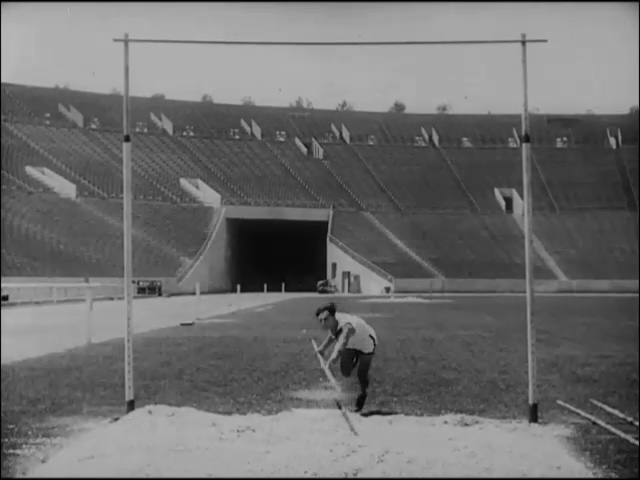
By now, Mary has begun to take notice of Ronald’s efforts to catch her attention. On the day of the boat race, Jeff gets expelled from Clayton. He then takes Mary hostage, in an effort to get her expelled as well so that she will marry him. Mary manages to telephone Ronald, who comes to the rescue, finding sudden athletic ability motivated by his damsel in distress. Now Ronald is running at Olympian speeds, clearing hedges like a high hurdler, pole vaulting into Mary’s dorm, and miraculously demonstrating skills in javelin, shot put, and tackle football to overcome Jeff and save Mary. A few more frames show Mary and Ronald marrying and living happily ever after, and the film closes with a shot of their gravestones together.
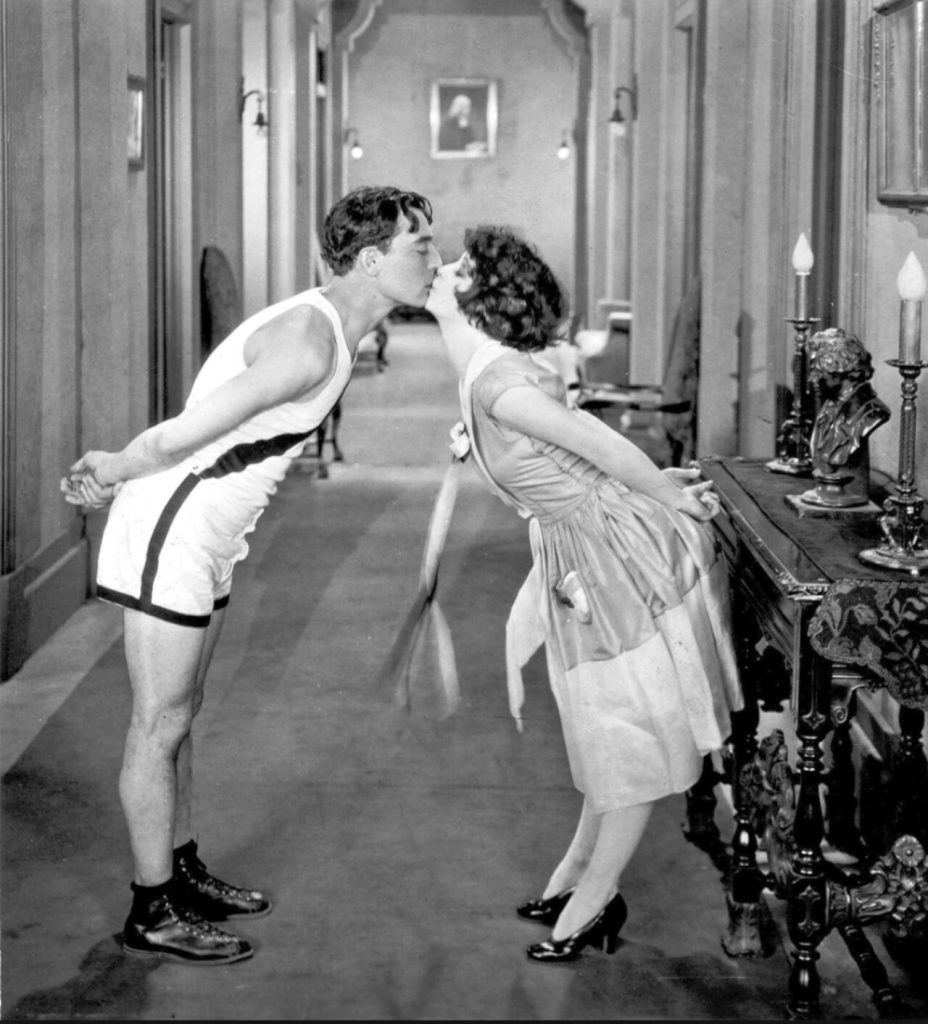
Keaton staged and performed almost all of the stunts in his movies. The professional pole vaulter he used in College was a rare exception. Reportedly, Keaton always regretted that decision. Keaton’s high tolerance for risk extended beyond fearlessness with his own physical safety. By the time College went into production in 1927, the uncontrollable cost overruns of Keaton’s self-directed prior films, especially The General, had created considerable tension between the studio and Keaton. In an attempt to control costs, Keaton’s business manager recommended that James W. Horne be hired as director for College. In a subsequent interview Keaton said that Horne was “absolutely worthless to me… I don’t know why we had him.” Initially Keaton’s role directing College was unacknowledged, but for posterity both men would eventually share credit.
College is hardly an original story. The idea of the anti-athlete protagonist vs. the athlete has plenty of precedent and can be found in countless stories and films that followed. The unique joy of College, though, is in Keaton’s application of implausibly ridiculous and outrageously physical gags to embellish the story-telling.
Stephen Prutsman’s Score
Stephen Prutsman’s original score for College is a gem that enhances the story at every turn. Listeners with knowledge of Bach cello suites will hear liberal and pervasive quotes from the Suite in G major, BWV 1007. This is no accident: at the time Prutsman composed the score for College, he was hearing his daughter practice the Suite daily, so it isn’t at all surprising that this music would have been in his consciousness. What is fascinating is how seamlessly Prutsman has adapted the old material to the film. If you know, you know, but the morphed Bach sounds so perfectly organic in its new context that anyone could be forgiven for missing it altogether.