
2025 marks the 80th anniversary of the end of World War II, the deadliest armed conflict in human history. On November 4 and 5, Guarneri Hall will commemorate this historic moment with a two-day concert series that explores themes of hope, remembrance, resilience, and despair found in the music of the times. In this article, we’ll look at the lives of five European composers whose works were deeply influenced by the war and its aftermath.
After the War
Europe emerged from World War II battered and broken. Cities lay in ruins, economies were paralyzed, and millions of people—uprooted by violence—were living as refugees, searching for a place and means to reclaim their lives. In the decade that followed, the continent grappled with more than just physical reconstruction. While individuals and communities competed for food and basics, global powers vied for land and influence, hoping to shape the future by winning over the minds and loyalties of those who had survived the war’s devastation.
The power of music as a socio-political influencer was not lost on the leaders of the emerging East and West. In the immediate aftermath of military hostilities, sharp lines of demarcation began to be drawn in the artistic world, following the new physical borders.
Artists became witting and unwitting tools in an emerging propaganda war between the West and the East. The musical artifacts of this time paint a fascinating and complex picture of artistic invention, deep humanitarianism, thinly veiled political dissidence, and, at other times, political acquiescence.
Persistence of Spirit

That great art can be born amid the rubble of war is a testament to the human spirit. The many ways in which the effects of World War II were expressed in music by the surviving musicians form a long and varied list, represented here by five examples:
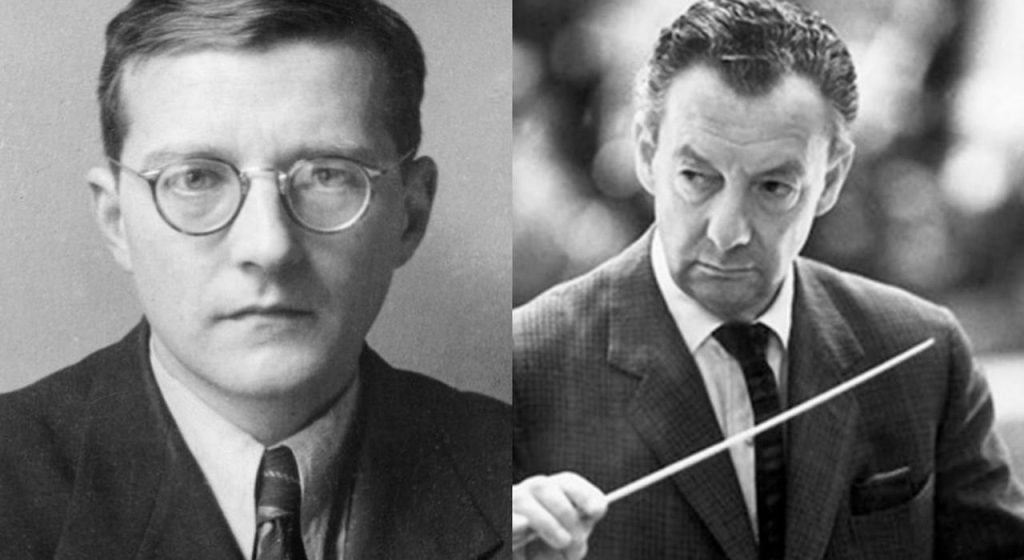
Dmitri Shostakovich’s Piano Trio No. 2, Op. 67, was composed in 1943-44 as the tide of the war was turning inexorably against Nazi Germany. In a reference to the ongoing atrocities of the war, the final movement of the trio, entitled “Dance of Death,” features Jewish themes. Shostakovich would use Jewish melodies in later compositions to similar effect.

Benjamin Britten’s Quartet #2, Op. 36 was written in 1945 in the immediate aftermath of the war. In July 1945, Britten performed at the recently liberated Bergen-Belsen concentration camp with violinist Yehudi Menuhin. The profound influence of this experience pervades the atmosphere of Britten’s Quartet #2, written over the ensuing months. Britten wrote to his longtime partner Peter Pears:
We traveled in a small car over bad roads, saw heavenly little German villages, completely destroyed towns, and millions of d.p.’s [displaced persons] – some of them in appalling states, who were thrilled to be played to. We stayed the night in [Bergen] Belsen…
Czech expat Bohuslav Martinů composed his Czech Rhapsody #2, H 307 in Cape Cod, Massachusetts, in July 1945 in the immediate aftermath of the war. Written for Fritz Kreisler, the Czech Rhapsody is an upbeat, virtuoso work that reflects the American exuberance at the end of the war and, with blazing Czech themes, Martinů’s national pride.
Polish Composer and violinist Szymon Laks wrote his String Quartet No. 3, “On Polish Folk Themes,” in 1945, after his release from Auschwitz-Birkenau concentration camp, where he was prisoner 49543. The piece employs regional Polish folk themes in an earthy celebration of Laks’ homeland.

Mieczysław Weinberg’s Piano Trio, Op. 24 was written in 1945 in Moscow. The strident and percussive effects, especially in the first and second movements, reflect Weinberg’s truly harrowing wartime experiences.
Weinberg came from a Jewish musical family in Warsaw in the newly independent Poland. He showed great talent and attended the Warsaw Conservatory from the age of 12. The offer of a chance to study in America was put off while Weinberg finished his diploma. The Nazi invasion of Poland in 1939 ultimately made the American adventure impossible. Weinberg fled Warsaw for the Soviet Union, but his sister and parents were unable to get out in time and perished in the Trawniki concentration camp.
Learn More – A Primer for 1945: At War’s End
As Guarneri Hall prepares to mark the 80th anniversary of the end of World War II with 1945: At War’s End, we invite you to explore the deeper stories behind the music with five pieces of reading material that echo the festival’s themes of resilience, remembrance, and reckoning.
Spanning history, folklore, dystopian fiction, and literary fantasy, these titles illuminate the complex realities faced by composers and civilians alike in the shadow of war. From the trauma of the Holocaust to the moral choices of survival, and from postwar grief to the search for meaning in a changed world, each piece offers a different lens through which to reflect on the music in our upcoming programs.
Whether you’re looking to contextualize the powerful works of Shostakovich, Britten, Weinberg, and others, or simply want to engage more deeply with the emotional terrain they inhabit, this reading list is a way to read – and listen – more closely.
Bloodlands: Europe Between Hitler and Stalin by Timothy Snyder
A harrowing and meticulously researched account of the mass killings that took place in Eastern Europe between 1933 and 1945, Bloodlands provides vital context for the wartime experiences of composers like Weinberg and Laks. Snyder charts the overlapping genocides committed by Nazi Germany and the Soviet Union, making visible the staggering civilian toll of policies that shaped the lives – and deaths – of millions. This essential history lends powerful insight into the geopolitical forces behind the music featured in our “Resilience” program.
Year Zero by Ian Buruma
Year Zero is a landmark reckoning with the great drama that ensued after war came to an end in 1945. One world had ended and a new, uncertain one was beginning. Regime change had come on a global scale: across much of Asia and all of continental Europe. The modern world emerged from the often vicious power struggles that ensued.
The Mighty Wurlitzer: How the CIA Played America by Hugh Wilford
CIA official Frank Wisner called the operation his “mighty Wurlitzer,” on which he could play any propaganda tune. In this illuminating book, Hugh Wilford provides the first comprehensive account of the clandestine relationship between the CIA and its front organizations. Using an unprecedented wealth of sources, he traces the rise and fall of America’s Cold War front network from its origins in the 1940s to its Third World expansion during the 1950s and ultimate collapse in the 1960s.
Time’s Echo: The Second World War, the Holocaust, and the Music of Remembrance by Jeremy Eichler
Named 2023’s History Book of the Year by The London Sunday Times, Time’s Echo explores how music can serve as the vessel of collective memory. Delving into Britten’s War Requiem, Shostakovich’s Babi Yar Symphony, Schoenberg’s Survivor from Warsaw, and Richard Strauss’s Metamorphosen, Eichler shows how, whether we want to forget what happened or others want us to forget what happens, music has the power to bear testimony: “Music remembers us.”
Savage Continent by Keith Lowe
In Savage Continent, Keith Lowe describes a Europe where individual Germans and collaborators were rounded up and summarily executed, where concentration camps were reopened, and violent anti-Semitism was reborn. In some of the monstrous acts of ethnic cleansing the world has ever seen, tens of millions were expelled from their ancestral homelands. The institutions that we now take for granted―such as police, media, transport, and local and national government―were either entirely absent or compromised. Crime rates soared, economies collapsed, and whole populations hovered on the brink of starvation.
Savage Continent is the story of post–war Europe, from the close of the war right to the establishment of an uneasy stability at the end of the 1940s.