
Guarneri Hall is proud to honor Pulitzer Prize-winning composer Bernard Rands with a two-day celebration of his 90th birthday. Tonight’s concert will feature four of Rands’ own compositions, as well as works by two composers who have close associations with him: Kathleen Ginther and Daniel Pesca.
Bernard Rands (b. 1934): Impromptu No. 3 for Solo Piano
Rands’ Impromptu No. 3 was commissioned by the Open Source Music Festival for pianist Joel Fan, who gave its premiere at the Abrons Arts Center in New York, NY, in November 2017. The brilliant pianist and composer Daniel Pesca, himself a frequent champion of Rands’ work, has adopted the piece into his own repertoire, first playing it in February 2019 at Fulton Recital Hall at The University of Chicago.
“The commission, issued jointly to Augusta Read Thomas and myself, specified that each composer create a work in reaction to an older music composition (not by us). We chose to react to Elliott Carter’s ‘Caténaires’ from his Two Thoughts About the Piano as a starting point. In response to requests from other pianists, three Impromptus were added. [Tonight’s performer] Daniel Pesca has recorded the complete set of ‘Four Impromptus’ in a superb rendering that awaits release.”
– Bernard Rands
Kathleen Ginther (b. 1951): Psalm of Love and Sorrow
Casey Ginther’s Psalm of Love and Sorrow was composed for the Duo Diorama (MingHuan Xu and Winston Choi) and the Chicago Composers Consortium. The work was premiered at the Chicago College of Performing Art at Roosevelt University as part of the school’s “PianoFest” in November 2022.
“There are many forms of psalms – psalms of praise and psalms of lamentation are prominent among them. Psalm of Love and Sorrow is both a lament and a love song, written in 2022 as the world emerged from the dark isolation of the COVID-19 pandemic. It is a study in stillness and serenity, interrupted by more active gestures that erupt from the low register of the piano, rising like a prayer into the violin’s higher reaches. There are moments of extreme fragility, quiet eloquence, and (perhaps) spirituality.”
– Kathleen Ginther
Bernard Rands: Walcott Songs
Bernard Rands composed this cycle of three songs based on texts by Derek Walcott in 2002-2004. He dedicated the work to Abigail and Norman Fischer, who premiered them at the Tanglewood Music Festival in 2006.

“These are not conventional ‘settings’ for voice with cello accompaniment, of poems to music – the poems are beautiful and powerful in their own right! Rather, the texts are analyzed and explored through fragmentation, reordering, repetitions, and changing pace of delivery. Thus the poems find new meanings and expression, in a musical context, often beyond that imagined or intended by the poet. The songs were composed between 2002 and 2004, in reverse order from their final performance order.”
“The first of these three songs, ‘The Fist,’ was commissioned by the Guggenheim Museum, New York, for a celebration of the West Indian-American poet. His readings were interspersed with short compositions by five American composers, each employing a Derek Walcott poem for voice and one instrument of their choosing. The cello has a dominant role as it pursues its ‘fantasia’ seemingly independent of the voice’s concerns.
“‘Midsummer, Tobago,’ commissioned by the Philadelphia Network for New Music, was the next to be composed. Here, the text is maximally processed, beginning with single, essential words, then combinations of two words, then three, etc., until the poem is finally delivered in its original format and integrity – the imagery and intensity intact. The cello is played pizzicato throughout, suggesting the timbre of a drum and the character of a calypso.
“Although composed last, ‘Endings’ states musical material that is carried through and embedded in the subsequent two songs.”
– Bernard Rand
Daniel Pesca (b. April 19, 1985): A Line for a Walk
Composer and Pianist Daniel Pesca has been a member of the University of Chicago’s groundbreaking Grossman Ensemble since its inception in 2018. Violinist Hannah Hurwitz, a fellow Grossman Ensemble member, commissioned A Line for a Walk and premiered it with the composer on piano at the Ear Taxi Festival, Epiphany Center for the Arts, Chicago, in October 2021.
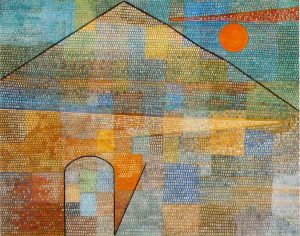
to my Line for a Walk”: Daniel Pesca
“A Line for a Walk is a sonata for violin and piano written for and dedicated to my longtime friend and collaborator Hanna Hurwitz. Named after Paul Klee’s adage about drawing, the piece follows a little melodic line — heard immediately at the beginning — as it moves through different environments: dreamy, playful, violent, and lyrical. This journey is divided into eight parts that flow together without break: four longer parts, three little ‘trampoline’ interludes, and a final short coda. Each of the short parts either recalls or foreshadows one of the non-adjacent longer parts. Even the longer parts are fairly short, lending the flow of the piece a gnomic character, reminiscent of the constrained canvas size Klee favored.
“The first three larger parts are:
- an opening ‘declaration,’ which introduces the main ideas of the sonata in a freely rhetorical manner
- ‘in the mists,’ in which plaintive violin melodies wander amid a drifting linear atmosphere in the piano
- ‘scherzo,’ a nervous, ephemeral dance between the two instruments, always on the verge of falling apart
“From this point on, the unfolding of the piece is more liquid and continuous, leading to an unexpected epilogue.”
“The piece was written just before the covid-19 pandemic, with all its disquiet and anxiety. The way the piece moves from a confident, forthright beginning to an unstable ending now seems somewhat prescient.”
– Daniel Pesca
Bernard Rands: Memo 6 for Solo Alto Saxophone
John Sampen and The Saxophone Studio and Alumni of Bowling Green State University, Ohio,, commissioned Memo 6 in 1998.
“Memo 6 for alto saxophone is one of eight works in the Memo series (now 9 with tomorrow night’s world premiere), which includes solo pieces for contrabass, trombone, harp, flute, piano, female voice, and oboe. Each addresses contemporary virtuosity in its respective medium. The title Memo (as in memorandum) suggests that the score be a reminder of each instrument’s heritage and repertoire as well as an urging to explore – through extensions of technique, aleatory opportunities, and score notations – new expressive potential.”
– Bernard Rands
Kathleen Ginther: “Épousailles”
Épousailles, or ‘Wedding,’ for voice and viola, was composed for Pinotage as part of the Outside the Box Festival of New Music in Carbondale, IL,, in 2007.

“Épousailles is a setting of a poem of that title by Guillaume Apollinaire. The text touches metaphorically on the relationship between love and absence – both essential elements within a relationship. In my setting of the poem, the voice and viola entwine around each other, forming a musical spiral from which neither can be extracted. ‘Épousailles’ is one movement of a large chamber piece of mine for voice, flute, viola, and harp entitled d’Apollinaire.
“The composition is an outgrowth of a piece called Les Roses d’Électricité (The Electric Roses), which was commissioned by the Utrecht Conservatory of Music in 1996. Les Rose d’Électricité is written for soprano, alto flute, English horn, bass clarinet and electronics; it is based on a fragment of a poem by Guillaume Apollinaire, and was premiered at the Utrecht Conservatory in Holland later that same year.”
“While writing Les Roses, I became mildly obsessed with the works of Guillaume Apollinaire and found myself returning to his poems between working on other pieces off and on over the next decade. In 2003 I completed a 3-song version of Chansons d’Apollinaire written for the Chicago-based ensemble Pinotage (mezzo-soprano, flute, viola and harp) who premiered it at New Music DePaul in 2003; four years later the Chansons had grown to include five movements, one of which was ‘Epousailles.’ The complete version (so far!) of Chansons d’Apollinaire, which included the newly composed ‘Épousailles,’ received its premiere in 2007 at the Outside the Box Festival of New Music in Carbondale, IL. It is the only one of the five chansons written for voice and viola alone; the other four are for voice, flute, viola and harp.”
– Kathleen Ginther
Bernard Rands: Prism (Memo 6b) for Saxophone Quartet
The New York State Council on the Arts and New Sounds Music, Inc. commissioned Prism for saxophone quartet in 2008. It is dedicated, “With love and admiration to Leah and Benjamin Barber.” The PRISM Saxophone Quartet premiered the work in Philadelphia, PA, in November 2008.
Prism (Memo 6b) is another instance in which Rands applies his technique of reinvention and recomposition. The original versionfor solo alto sax is on tonight’s program as a window to the compositional process. This version of Memo 6 takes the essential components of the original solo work and recasts it through the prism of a saxophone quartet.