
Bernard Rands’ death last week at the age of 92 marked the end of an era. For decades, Rands had been a central figure in the arts landscape of Chicago, from where he composed many extraordinary pieces and lent his support to musicians all over the world. His loss is profoundly personal for us at Guarneri Hall, where he was a frequent guest and supporter. Guarneri Hall has featured a number of his works in concert. We celebrated Rands’ 85th birthday in 2019 with an evening dedicated to his music, and presented the Rands@90 festival in 2024 dedicated to his music and the composers he influenced. A pair of these performances are archived on our YouTube channel including the world premiere of Memo 9, which Rands wrote for NEXUS Chamber Music co-Artistic Director Alexander Hersh.

Bernard Rands was born in Sheffield, England, and established himself as a leading avant-garde composer in Europe before migrating to the US in the 1970s. He was among the last surviving composers of the group who had been mentored by avant-garde masters Bruno Maderna and Pierre Boulez at the Darmstadt Ferienkurse in Germany. Before settling in Chicago, Rands taught at Princeton University, the University of Illinois, the University of California, San Diego, Yale, Juilliard, Boston University, and Harvard. In 1984 he won a Pulitzer Prize in Music for his song cycle Canti del Sol. He served as composer-in-residence with the Philadelphia Orchestra from 1989 until 1995. Rands’ works are often performed by the world’s leading orchestras, especially in the US.
I first met Bernard at a winter music festival at Colorado College in the late 1990’s, where his tightly constructed Scherzi from 1974 would be my first foray into his imaginative and varied musical world. Bernard was a kind but precise coach as we worked to ready a performance of Scherzi, beginning a friendship that would deepen greatly over the decades that followed.
In the years after that first encounter, I had the incredible good fortune to learn many of Bernard’s ravishing compositions both as a performer and as a listener. Highlights include his 2nd and 3rd String Quartets, his Music for Shoko-Aubade for English horn and string quartet, his Wolcott Songs for soprano and cello, and his Memo series of 13 works for solo instruments, each numbered sequentially. Rands’ mastery and inspiration come through in each of these gems, but it was in his symphonic and operatic music where Bernard seemed able to express himself most fully. His generous orchestrational style became ever more beautiful toward the end of his career. The lush soundscapes of Bernard’s single-movement Symphonic Fantasy, premiered in 2022, pay discreet homage to Bernard’s hero Debussy while sounding completely fresh and new.
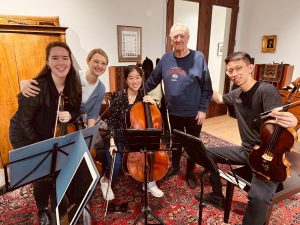
Getting to know these works and to speak with Bernard personally about them was an enormous privilege for all of us in the large community of musicians that he called friends. Bernard was patient and generous with musicians when we struggled to navigate challenging sections of his music. His breadth of musical knowledge was as complete as that of anyone I have encountered, as was his ability to be outspoken about repertoire from all periods without being brash. But Bernard’s intellectual curiosity extended well beyond music to a wide range of interests including literature, art, languages, and politics. An evening with Bernard could easily include conversation covering any or all of these topics; truly, there was never a dull moment in his presence.
Bernard’s depth and expressiveness as a composer, his intellectual range, and his heartfelt humanity has been an inspiration not only to me personally, but also to many of my family, my friends, and colleagues. His was a long and incredibly fruitful life, lived very much to the fullest. Saying goodbye to such a wonderful friend is never easy. While those of us lucky enough to know Bernard will treasure our personal memories, his gorgeous music remains an amazing gift to the whole world.