

Hanns Eisler (1898-1962) was many things: prize-winning composer, star pupil and protégé of Arnold Schoenberg, faculty member at three distinguished institutions, creative partner of Bertolt Brecht for 30 years, co-author of one of the first studies of film music aesthetics, and two-time Academy Award nominee. He inspired an international cohort of supporters including Eleanor Roosevelt, Albert Einstein, Pablo Picasso, Thomas Mann, Leonard Bernstein, Igor Stravinsky, and Aaron Copland. He collaborated with some of the greatest auteurs and directors of his time including Fritz Lang, Joseph Losey, Charlie Chaplin, and Jean Renoir. He wrote the music for the first Holocaust documentary, the harrowing Night and Fog. He was so well known that Woody Guthrie wrote a song about him.
Hanns Eisler was also a wanderer, ever in search of a place where he could work without fear and, through his art, serve people of all classes. Some of his journeys were voluntary, some forced. Born in Leipzig and raised in Vienna, after serving on the Eastern Front in World War I he drifted back to Vienna and then moved to Berlin. Later expelled from Germany by the Nazis, he worked itinerantly in Paris, Copenhagen, London, Strasbourg, Moscow, New York, Barcelona, Brussels, Amsterdam, Madrid, and Prague, before fleeing to New York and then Los Angeles, from where he was also expelled, relocating to Vienna and finally settling in Communist East Berlin.
But here in the U.S., for the most part Hanns Eisler is simply forgotten. After World War II his presence was erased from the American musical scene, his influence quashed. British musicologist (and student of Eisler) David Blake asserted in 2000, “no composer has suffered more from the post-1945 cultural cold war.”
Vienna and Schoenberg
Eisler’s compositional talent emerged during his youth in Vienna. Because his family could not afford music lessons for him, he taught himself. After two years of conscripted service in the Austro-Hungarian army during which he wrote anti-war songs, he returned to Vienna to pursue serious musical education at the Vienna Music Academy. Unsatisfied with the instruction there, he joined the cadre of Arnold Schoenberg’s pupils, where he flourished under Schoenberg’s rigorous tutelage despite his lack of formal training.
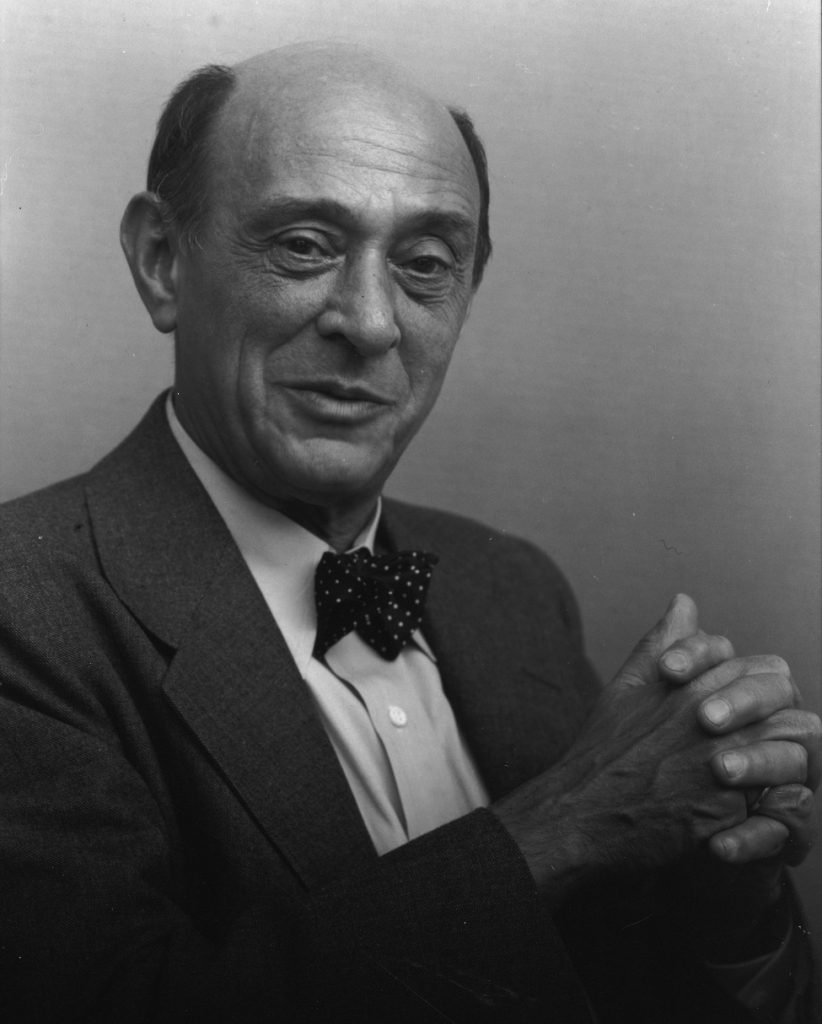
Eisler and Schoenberg grew close. Besides teaching him at no charge, Schoenberg facilitated publication of Eisler’s compositions. Eisler credited Schoenberg with making the strongest musical impact on his life: “It was really there that I first learned musical understanding and thinking.” But the jobs he took in Vienna to support himself, conducting three workers’ choirs and providing basic musical instruction for workers at the city’s Society for the Promotion of Popular Music, sparked soul-searching. Music, he now believed, must communicate with the common man and serve practical, relevant functions in society. While Schoenberg was obsessed with forging the music of the future through his own esoteric system, Eisler no longer wanted to make music for an enlightened elite, or simply for art’s sake. Teacher and pupil argued and parted bitterly, and Eisler moved to Berlin in 1925.
A New Type of Artist
Eisler had developed deep convictions about the purpose of music: “Music springs from the social order and the artist is the instrument of that expression. A new type of artist will be he who directly reflects that social condition.” The path to these convictions led through some of the most profound crises of his century, into which he immersed himself fully. In 1928 he scolded young composers for their spiritual isolation from the world, reminding them that they lived among divided classes of human beings engaged in “the most gigantic social struggle in the history of mankind,” and challenging them to understand how real people managed in their own day and age.
Eisler was this type of new composer. Not content to observe, he worked hard at collaboration. Social interaction was now his goal; bringing people together in a collective exercise of music-making became imperative. His large-scale works like symphonies and cantatas combined music with theatre, poetry, and dance, to maximize their impact and social relevance. Believing that composers and audiences could and should learn from each other, he communicated directly with performers and listeners, accompanied rehearsals at the piano, sang his songs with them in rallies and meeting halls, eschewing the concert hall for the cabaret and the streets. As Eisler himself noted wryly, “Rent in the ivory tower is getting too high anyway.”
Berlin and Brecht
1920s Berlin was the center of the German workers’ movement. Eisler began teaching at the Klindworth-Scharwenka Conservatory and set out to serve “those who neither pay for art nor are paid for art, but want to make art.” He composed political and protest songs, many for choirs affiliated with the 450,000-member German Workers’ Singers’ Association, including a piece based on the story of legendary American protest singer Joe Hill. A song cycle based on newspaper clippings of wedding announcements and children’s songs was his self-described “farewell to the bourgeois concert stage.” As music critic for The Red Flag, the German Communist Party newspaper, he wrote over 30 essays on modern music. While in Berlin he kindled a long and fruitful partnership with Bertolt Brecht which resulted in theatrical collaborations, films, cabaret shows, and many songs. Their major accomplishment during this time was the 1930 cantata The Measures Taken, which dramatizes a successful workers’ uprising.

When Hitler rose to power in 1933, Eisler’s Jewish heritage, Marxist activism, and incendiary compositions placed him in danger. He fled Berlin immediately after his music was banned and for the next five years he traveled across Europe, working on film projects, composing music for workers’ rights and anti-fascist causes, and joining political actions. In 1938 the New School for Social Research in New York offered him a six-month visiting lectureship. Visa approval was delayed because of his Marxist leanings, but eventually he was able to enter the U.S. There he taught, composed, worked with filmmakers and directors, and began his study of film music. His association with the European avant-garde and his many accomplishments garnered friends and admirers in New York. But many years on the run had taught him circumspection; he now avoided open association with left-wing politics.
After his temporary visa expired in March 1939, he successfully petitioned for asylum in Mexico and began teaching there while applying for a re-entry visa to the U.S. But while he was working in Mexico, the State Department declined his visa application and ordered his deportation to Europe. For Eisler, a Jew and ally of socialism, this was equivalent to a death sentence. He remained in Mexico until he was finally able to obtain a visa from the U.S. Consul in Mexicali, and safely returned to New York in October 1940 to resume his research on film music, the fruits of which were four film scores and the book Composing for the Films.
Hollywood

In 1942 his former collaborator Berthold Brecht, who by then had emigrated to the U.S., invited Eisler to join him in California to teach at the University of Southern California and work in the film industry. Eisler readily accepted, embarking on a five-year period of financial stability made possible by his film experience and the adaptability he had learned in exile. He wrote the music for eight motion pictures, earning two Academy Award nominations: Fritz Lang’s 1942 Hangmen Also Die and None but the Lonely Heart in 1944, starring Cary Grant. His renewed partnership with Brecht produced the 11-movement anti-Nazi cantata Deutsche-Sinfonie and the diverse 50-song collection Hollywood Songbook. The latter explores Eisler’s feelings of alienation within the artificial, capitalistic “dream factory” of Hollywood, which prized profit above creativity and had little interest in the class struggles that had long engaged him.
“A dangerous socialist sympathizer”
It has been suggested that Eisler’s Hollywood success brought him in 1947 to the attention of the House Un-American Activities Committee (HUAC), a body wielding significant power whose rabid pursuit of suspected Communist spies dominated U.S. politics during the Cold War era. But in truth, since 1939 the U.S. government had already viewed Eisler (tainted by association with his brother Gerhart, a known Communist agent) as a dangerous socialist sympathizer and activist; his visa difficulties attest to the State Department’s many attempts to keep him out of the country.

So, while HUAC whipped up public hysteria with its efforts to “cleanse” Hollywood of traitors and spies, J. Edgar Hoover’s FBI assembled a 600-page document on Eisler’s activities. This led to an interrogation by HUAC, during which its head investigator Robert Stripling publicly condemned Eisler as the “Karl Marx of Communism in the music world.” Eisler refuted the charge of party membership, denied participation or interest in American politics, and claimed that while he thought the Communists heroic, “I am not a hero. I am a composer.” But he was not allowed to offer a statement, and though unable to prove any of the allegations against him, the Committee ordered the State Department to begin deportation proceedings. Musical luminaries, artists, and intellectuals from the U.S. and Europe tried to intercede on his behalf with letters and petitions; Bernstein, Copland, David Diamond, Randall Thompson, and others mounted a Town Hall concert of his music to protest the travesty. All efforts proved futile, however, and in February 1948 the deportation warrant was issued.
Composer S.L.M. Barlow, in a fiery defense published in the New York Times on February 22, 1948, called out the government’s persecution campaign: “Walls, as revolting as those of a Dachau, may be built out of smears….We must each of us share the shame and be…roused from our comfortable acceptances, for if we do not share the wrongs, we may have to share the fate.” Eisler read his own defiant statement to the press on the day he boarded a plane to Prague in March 1948: “I leave this country not without bitterness and infuriation… As an old anti-Fascist it became plain to me that these men represent fascism in its most direct form… But I take with me the image of the real American people whom I love.” Nevertheless, this shaming episode and his eventual retreat to Communist East Germany, isolated from the West, took their toll and he faded from awareness in America.
Arising from the Ruins
Eisler tried to resettle in Vienna but after two years found the city provincial and inhospitable. No one there would hire him, and he felt its anti-Semitism and opposition to progressive ideas. Thus, with high hopes he moved once again to the newly established socialist workers’ state of East Germany. Things seemed promising. He wrote a song on Johannes Becher’s poem “Arising from the Ruins” which was formally adopted in 1950 as East Germany’s national anthem. He became a professor at the Berlin Hochschule für Musik. But two years later, he was shocked when the libretto he published for his opera project Johannes Faustus was censured publicly by the Communist Party for not idealizing German history and its cultural hero Goethe. The project was suppressed and never completed. Then, Eisler’s defense of his teacher Schoenberg as a pioneer of modernism brought him ridicule as a formalist and traitor to socialist realism. Brecht’s death in 1957 and the construction of the Berlin Wall in 1959 further depleted his optimism. Still, Eisler persevered, writing songs and film scores, teaching and writing, until his death in 1962.
An Emerging Legacy
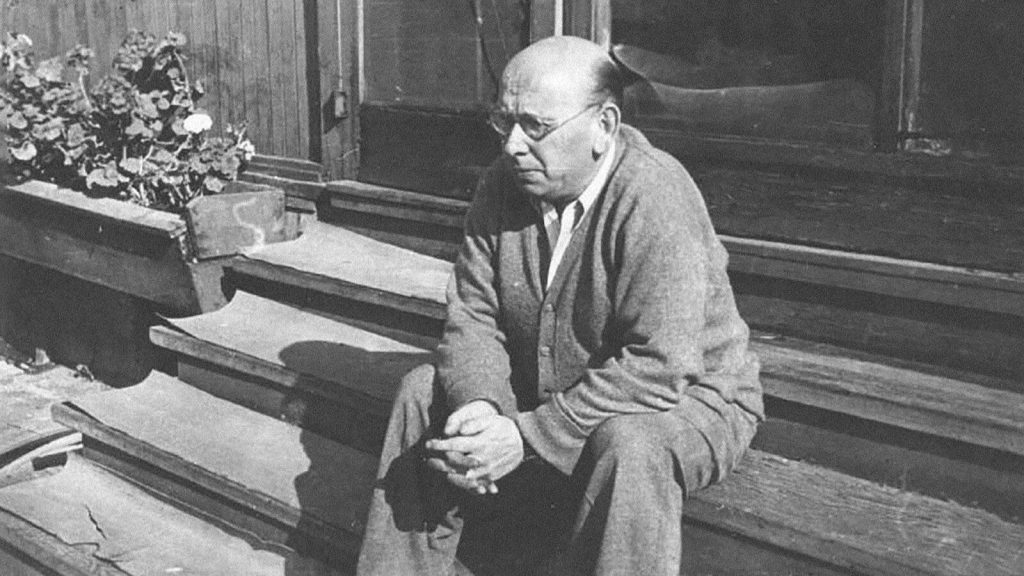
Slowly, recognition of Eisler’s legacy is emerging. In 1964 the school where he had taught was renamed the Hochschule für Musik “Hanns Eisler” in his honor. Articles and books have appeared, performances and recordings of his music are more frequent, and in 1994 a critical edition of his collected works and the International Hanns Eisler Society were launched in unified Germany. Recently Breitkopf und Härtel issued his complete correspondence in six volumes. One of the most interesting tributes is German composer Heiner Goebbels’s 2013 Eislermaterial, a collage of excerpts from Eisler’s vocal and instrumental music interspersed with recordings of his voice, ambient noise, and bits of original music by Goebbels.
Perhaps Heiner Goebbels is correct that we are ready again to listen carefully to what Eisler has to say. As Dmitri Shostakovich stated, “Eisler will remain for all of us the magnificent example of a musician who was always to be found in the front ranks and who actively used his creative powers for progress and peace, in the struggle for a new and just society and for a better future.”