
Composers György Ligeti (1923-2006) and György Kurtág (b.1926) first met in Budapest in the fall of 1945. Each of them had crossed illegally into Hungary from their native Romania to study at the Franz Liszt Academy under Béla Bartók, whose expected return from New York that fall was eagerly anticipated. It was not to be: Bartók succumbed to leukemia in September 1945 before he could return to Budapest. Still, Ligeti and Kurtág became lifelong friends even as they went on to lead very different artistic and personal lives. Bartók’s posthumous influence remained central to each of them even as their personal compositional styles developed independently from one another.
Defection and Exile
The Hungarian uprising of 1956 profoundly affected both men. Ligeti defected to Vienna in 1956 and spent the rest of his life in the West, eventually taking Austrian citizenship. Kurtág went on a self-imposed exile in Paris from 1957-58, studying there with Max Deutsch, Olivier Messiaen, and Darius Milhaud. It was in Paris that Kurtág first encountered the music of Anton Webern, which would profoundly shape his mature voice alongside the shadow of Bartók.
In Paris, Kurtág found the freedoms of the West liberating:
I remember suddenly noticing how Márta and I spoke to each other on the street, and that we no longer had to lower our voices. That was when I understood how scared we had been.”
Nonetheless, Kurtág returned to Budapest in 1958. His creative output thereafter would come from communist-controlled Hungary, until the fall of the USSR.
Reverence for Bartók
Ligeti and Kurtág’s shared early backgrounds, reverence for Bartók, and enduring East/West friendship invite an interesting musical comparison. Ligeti composed in a wide range of musical styles. Consistent with the artistic tolerance he encountered in the West, from 1956 onward, Ligeti’s output marked him as a post-war avant-garde experimentalist. Kurtág, on the other hand, focused on a dense style that owes much to the pre-war models of Bartok and, in its hyper-reductive, hyper-expressive focus, to the music of Anton Webern. Tonight’s program juxtaposes Ligeti’s experimental and sometimes ground-breaking range with Kurtág’s compressed, introspective expressive immediacy, through a series of personal and musical Homages.
György Ligeti Hommage à Hilding Rosenberg (1982)
Ligeti met the famous Swedish composer Hilding Rosenberg (1892-1985) as a fellow teacher of composition at the University of Stockholm in the 1960s. Ligeti wrote this musical homage to commemorate Rosenberg’s 90th birthday. He subtitled the little piece: “Hyllning for Hilding Rosenbergs födelsedag (med besvaret av Bartok’s anda),” which translates from Swedish as “Tribute to Hilding Rosenberg’s birthday (answered by Bartok’s spirit).”
This short work for violin and viola is accessible and idiomatic to the instruments and is relatively easy to hear and to play. The piece owes much to the Eastern European folk music influence found in Bartok and Kodaly string duos, but it is unmistakably Ligeti’s voice. While much of Ligeti’s music could be fiercely challenging for performers and listeners alike, this charming piece demonstrates that nothing about his personal style prevented him from composing tonal pieces.
György Kurtág: Officium Breve, in memoriam Andreae Szervánszky, opus 28 (1989)
The title of this work references Andreae Szervánszky (1911-1977), a Hungarian composer whose friendship with Kurtág, and embrace of Anton Webern’s techniques profoundly influenced Kurtág. Kurtág spent over ten years on Officium breve, completing it in 1989. Its 15 short movements last about eleven and a half minutes in total. With Officium breve, Kurtág explores Webern’s compositional ideas through which both he and Szervánszky found their mature aesthetic.
But Officium breve is more than just a memorial to Szervánszky. In fact, it is a deeply personal series of memorials to various friends, colleagues, and influences of Kurtág, including, prominently, Anton Webern himself.
The first movement is a modified transcription of an unpublished piece entitled “Virág az ember (Turcsányi Tibor emlékére)” which translates as: “Man is a flower (in memory of Tibor Turcsányi).” As the title suggests, it is dedicated to the late cellist Tibor Turcsányi and composed as a variation on the ‘flower’ motto from Kurtág’s op. 7. The second movement of Officium breve is a modified transcription of an unpublished Kurtág piece entitled “In memoriam Baranyai Szolt.” Szolt was a highly regarded mathematician and a skilled recorder player, reflected in the piece’s original, pre-quartet instrumentation of two recorders with harp or harmonium.

The third movement, a duo for viola and cello, is a transcription of a 1973 work, “Silence: Homage to Szervánszky.” Kurtág has called the piece a “quasi skeletonic” version of the Szervánszky ‘Arioso,’ which appears later in Officium breve. Movement IV vaguely references a fragment of the Cantata, Gelockert aus dem Schoße, Anton Webern’s last completed piece. Here, for the first time in Officium breve, Kurtág begins to employ Webern’s serial technique.
Various treatments of the material in Gelockert aus dem Schoße are the basis for movements V, VI, subtitled “Hommage a Webern,” and VII, in which the Webern material is rendered in its entirety. Movement VIII is a transcription of a piece entitled “Virág Garzó Gabriellának” (“A Flower for Gabriella Garzó”), and movement IX is original music composed for Officium breve.
Movements X and Xa return to the development of material based on Webern’s Gelockert aus dem Schoße. Movement XI and XII are transcriptions of earlier Kurtág works: “In memoriam György Szoltsányi,” and “Silence – Hommage à Szervánszky.”
As with Movement VIII, Movement XIII is based on “A Flower for Gabriella Garzó.” In Movement XIV, Kurtág employs a biting dissonance that is most closely related to the modernist compositions of Bartók dating from the 1920s. This movement’s stridency and intensity reach the highest tension point in Officium breve, from which movement XV is a release.
In movement XV, Officium breve ends with a simple chord and an incredibly tender and affecting tonal quotation from Szervánszky’s “Arioso” that appropriately inspires deep reverence. In the years since its publication, Officium breve has taken its rightful place as one of the most revered works in the late 20th-century string quartet canon.
György Kurtág: Six Moments Musicaux (2005)
Kurtág composed Six Moments Musicaux, Op 44 between 1999 and 2005, by which time he was in his mid-seventies. With their extended lyrical sections, these pieces show less of the Webern-like miniaturization than in many of Kurtág’s earlier pieces. Is the stylistic evolution reflected in Six Moments Musicaux the result of a change in attitude born of life under a less oppressive political system? It is impossible to say for sure, but it is tempting to speculate.

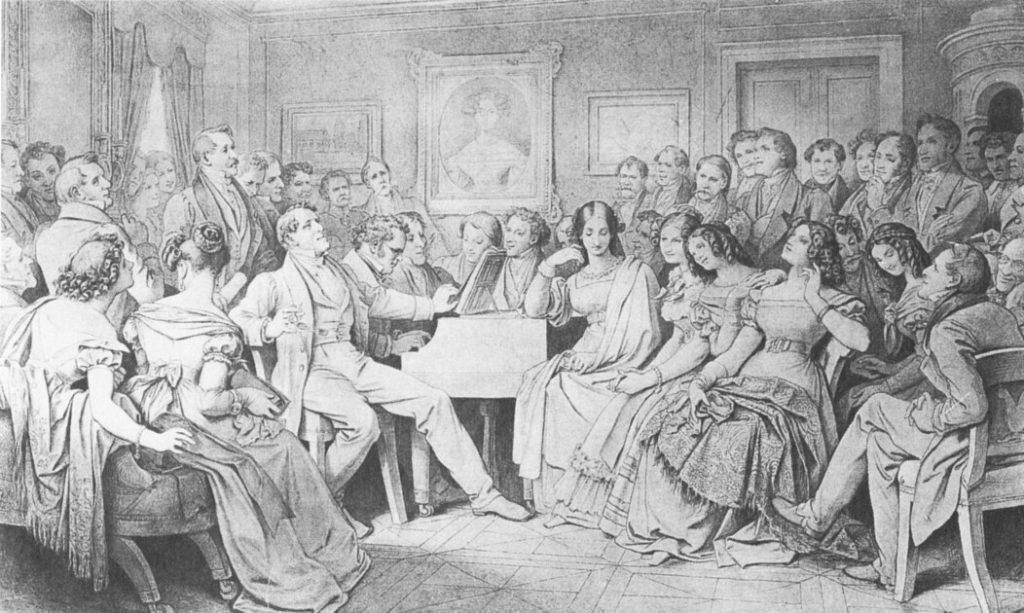
Dedicated to Kurtág’s son, György Kurtág, Jr., Six Moments Musicaux are modeled after Schubert’s solo piano pieces of the same name. Each of the individual pieces encapsulates a unique, self-contained sound world. The first piece, “Invocatio” (invocation), is a dramatic and tense series of biting fragments signaling the start of an important event. The second, “Footfalls,” is fitful, with hesitant, menacing, lyrical, and tentative material holding suspense throughout. The third piece, “Capriccio,” is pointillistic, exploiting rapid register changes and sharp interjections. The fourth piece is a haunting elegy for Hungarian pianist György Sebök, 1922-1999.
In the fourth piece, “Rappel des oiseaux (etude pour les harmoniques)” (“Bird calls (study for harmonics),” Kurtág uses harmonics almost exclusively, re-creating bird calls to great effect. Here, the influence of Olivier Messiaen, with whom Kurtág studied during his Parisian exile, is unmistakable. The final piece, “Les Adieux (in Janáček’s manier),” refers to Czech composer Leoš Janáček, whose style is a source of inspiration for the lyricism, interjection, and repetition of this musical “goodbye.”
György Ligeti: Trio for Violin, Horn and Piano (1982)
After composing the opera Le Grand Macabre in 1978, Ligeti went silent for a number of years. Then, in 1982, pianist Eckart Besch suggested that Ligeti consider composing a piece for horn trio as a companion piece to Johannes Brahms’ Horn Trio. Ligeti later recounted the moment:
As soon as he pronounced the word ‘horn,’ somewhere inside my head I heard the sound of a horn as if coming from a distant forest in a fairy tale, just as in a poem by Eichendorff.”
Ligeti’s mother, virtually his only relative to have also survived the camps during the holocaust, passed away in 1982, so perhaps it is no coincidence that Ligeti’s horn trio is notated Hommage à Brahms, and the slow movement Brahms’ trio is an elegy for his mother who had passed shortly before it was composed.
By this point in his development, Ligeti had experimented with a wide range of novel and experimental compositional modes. By that measure, the trio marks something of a retreat to earlier forms: its four-movement structure, a scherzo, and a passacaglia all borrow from the formats for older musical works. Despite the use of these old forms, Ligeti’s horn trio is a truly contemporary and even visionary work. Traditional hunting motifs are inventively abstracted. Naturally occurring clashes between the overtones of the horn and the piano are exploited in unprecedented ways. With his Horn Trio, Ligeti found a fresh path to a new style that was, in his words, neither a cliché of the reactionary nor the avant-garde.
The first movement, Andantino con tenerezza, opens with a lyrical duet between horn and violin. The material is an inverted version of the ‘farewell’ theme from Beethoven’s sonata Les Adieux, perhaps a reference to the passing of Ligeti’s mother. Occasional piano interjections serve as connective tissue between phrases. The music gains urgency with dramatic upward flourishes in the horn, with these sections alternating and returning to the opening material before all dissolves in a slow upward arc.
The second movement, marked Vivacissimo molto ritmico, is an exciting, and increasingly frenetic exploration of Bulgarian rhythmic variation against a steady ostinato, reflecting the strong influence of Bartók. Finally, the energy gives way to another slow, upward-arcing dissolve.
The third movement, Alla marcia, also borrows from Bulgarian rhythms. Here Ligeti uses an unusual technique of repeating the march material but shifting the rhythmic juxtaposition of the instruments by one beat in each repeat, giving the music a haunting familiarity even as the herky-jerky march takes on new harmonic and rhythmic cross relationships. The “B” section defaults to smoother ascending material before the return of the repeated march brings us to the end of the movement in heroic fashion.
The fourth movement marked Lamento. Adagio is a poignant and somber elegy. Perhaps here, Ligeti is truly mourning the death of his mother. A profound sense of loss and resignation is rendered in universal dimensions, with the three instruments in alternating solos, in duos, or all together carrying the primary thematic material. The arc of the music builds in intensity with the piano and horn in their lowest registers against the violin in harmonics in its highest register. The violin drifts downward and the piano upward, signaling a more hopeful tone and the faintest possibility of emerging unity as the piece fades to a close.
Ligeti’s trio marks the beginning of the third and final period of his output. Ligeti described this emergent style as neither modern nor postmodern, reactionary, or avant-garde. The trio reflects this new compositional style. Its use of old forms is evolutionary in the way it borrows from tradition, and revolutionary in the ways those forms are stretched and in the inordinate demands the stretching makes of the performers.
Like Kurtág’s Officium Breve, the Ligeti Horn Trio has emerged as one of the most admired works of the second half of the 20th century.