The Music of Hanns Eisler (1898-1962)
Hanns Eisler lived much of his life on the road. To be of use to workers in the class struggle and to deliver a message of strength and solidarity to the forces opposing fascism were his lifelong goals. His proletarian songs made their way to London, Paris, Berlin, Detroit, and China. He traveled in person to many other sites of struggle in Europe, the Soviet Union, and the United States throughout the 1930s. When the leaders of the International Brigades fighting against the Nationalists and Franco in the Spanish Civil War needed him to organize a concert in Madrid, but realized that he was in near constant demand, they delivered their invitation as a little poem which began: “Comrade Eisler, where are you now? At the pole, in New York, or in Moscow?”
Not all roads taken were of Eisler’s choosing, however. In 1933 he fled Germany, his adopted homeland, to escape the Nazis. He lived an itinerant existence until 1938, when he emigrated to America, eventually settling in Los Angeles. Though he built a life and enjoyed success there, too, as a film composer, his history of leftist activism rendered him vulnerable in the post-war Red Scare. In 1947, he was the first Hollywood artist called before the House Un-American Activities Committee, which order l ed him deported the following year. He traveled back to a Europe that, after World War II and the developing Cold War, was far different from the one he had left 15 years earlier.

As many writers have observed, Eisler’s persistent state of homelessness tends to unfairly overshadow the value of his contributions to modern music and culture. This is especially true in the West, even though he was a respected composer with close ties to the Second Viennese School, Bertolt Brecht’s most important collaborator, and an honored innovator of film music. Yet it is a compelling chronicle of exile and estrangement. Based on Brecht’s poem “The Landscape of Exile,” the closing song is from a set Eisler composed while in Hollywood. It describes Brecht’s own flight to safety in America via Denmark, Russia, and the Philippines. The oil derricks, fragrant gardens, shady ravines, and fruit markets of California did not ultimately leave Brecht, the “messenger of unhappiness,” unmoved – but at the same time, Hollywood was not and could never be Eisler’s or Brecht’s home. Still unhappy, Eisler remembered in another song in his set that “no one knows me here.”
Albrecht Betz, the author of one of the few studies of Eisler available in English, contends that the three most important influences on Eisler’s development were revolutions: the major social upheavals of World War I and the Russian Revolution, Arnold Schoenberg’s atonal and twelve-tone compositions which revolutionized music, and the arrival of the mass media (radio, phonograph, and sound films) which revolutionized artistic function.
It is worth considering a fourth revolution to be a formative influence on Eisler’s output and life: the Cold War, which set up bitter opposition between the ideologies and governmental systems of East and West, upsetting and reconfiguring international alliances, economic systems, social structures and political stability across the globe. The works on this program demonstrate the influences of all four of these revolutions, and more importantly, were all created at times when Eisler was living in exile in a land that often felt foreign, either America or a Berlin that bore little resemblance to the city he had once called home. You can read more about Hanns Eisler here.
Tonight’s program opens with five vocal selections, in recognition of their importance of song to Eisler. Vocal works far outnumber other genres in his creative output: 9 major compositions for solo voice, chorus, and orchestra; 5 for solo voice and large orchestra and more than 50 large- and small-scale works for voice and chamber orchestra; 11 for voice and chamber ensemble; over 250 songs for voice and piano; and 54 pieces for unaccompanied chorus.
Each of these songs grapples with the stark reality of a distinct moment in the psychic life of the displaced person: the fear of isolation; performing simple tasks as if fleeing one’s home were not imminent; remembering the sounds and sights of a beloved city; the perception of being stuck in the harsh no man’s land between the “official version” of modern society and the reality that falls far short. Yet there is no trace of sentimentality or finality in either text or music. The language is understated as befits the stoic acceptance of bad news and loss; the ironic smirk sweeps away any idealizing of past or present. None of these songs is a closed book. Eisler seems to be telling us that we must examine the past we have survived so that we can come to terms with the present and face the unknown future.
Selections from The Hollywood Songbook (1942)
An den kleinen Radioapparat/To the portable radio (text: Bertolt Brecht) (1942)
Ostersonntag/Easter Sunday (text: Bertolt Brecht) (1942)
Writer of plays and lyric poetry, Bertolt Brecht (1898-1956) was an innovator who created a new form of epic theatre, which served as a vehicle for the expression of anti-war and socialist ideologies. Brecht’s most famous early anti-bourgeois works were the ballad operas, The Threepenny Opera, and The Rise and Fall of the City of Mahoganny, written in collaboration with Kurt Weill. Following his close study of Marxism, he began to produce short didactic plays called Lehrstücke and to break away from conventional dramatic styles.

Brecht’s epic theatre employs a narrative or chronicle as a structure and aims to detach the audience from the action, reducing the spectators’ emotional involvement with the characters in favor of stimulating their critical judgment about human behavior. He believed that theatre was the most effective means of communication and employed language inventively, without recourse to rhythmic verse. Brecht was also a prolific poet whose diverse output addressed both personal and political themes.
Brecht and Eisler began their 30-year friendship and fruitful artistic partnership in 1930, when Eisler wrote music for several Lehrstücke. Their major works of the 1930s included the anti-Fascist play The Round Heads and the Pointy Heads, the proletarian cantata The Measures Taken, and The Mother, Brecht’s adaptation of a novel by Maxim Gorky. Brecht was Eisler’s most important literary collaborator; they continued to work together after reuniting in Hollywood in the 1940s, and in Berlin after the war.
Brecht figures significantly in Eisler’s enigmatic song collection, The Hollywood Songbook, supplying over half the texts for the 47 pieces included. Written during his first 2 years in Hollywood, the collection sets poetry or fragments from 9 writers besides Brecht (Mörike, Eichendorff, Goethe, Viertel, Pascal, Rimbaud, the Bible, Hölderlin, and Eisler himself), presenting a mix of languages and eras. Eisler never determined the order of the complete set and he did not appear concerned that it be viewed as a coherent whole.
Portions of the set, the 6 Hölderlin Fragments, and the 5 Elegies by Brecht are often extracted and performed on their own. Once settled in Berlin, Eisler allowed the songs to be issued in three different volumes; the complete Songbook was not published in a single volume until 1976, with the first complete performance in 1982 – 20 years after Eisler’s death. Yet considered as a whole, the Songbook does make sense; it expresses the opposite of coherence and continuity because those no longer exist in the life of the exile, and it presents a parade of disparate images from the exile’s remote past, whose order and appearance in his mind’s eye he cannot control.
The mechanical clicking of radio static in the guise of repeated notes permeates “To the Portable Radio.” Those moments when the repeated notes disappear from the texture are therefore the scariest ones. The phrases, for the most part, stay within a close range, so the two lines that employ the wide-ranging melody at the end of each verse stick out, revealing the heart of the matter: “I need to hear the hated jargon spoken…just promise me you won’t go dead again.” That it might stop is the singer’s worst fear; being able to hear even the bad news means he is still connected to the outside world.
“Easter Sunday” contrasts vulnerable nature and a father and son’s solicitous effort to prevent its destruction with the threat of destruction that faces humanity. Calm, methodical, repeated chords and a placid, speech-like melody portray the description of the gentle snowstorm at the opening and the wrapping of the tree at the end. Each human’s expression conveys the urgency to act – first the son, through a more active melody, wanting to save the tree, and then, almost hysterically, the father who sees that it is his whole country, family, and himself who needs saving: here the rhythm is more insistent, the chords thicker, the range higher, the melody more angular and dissonant.
An eine Stadt/To a city “Heidelberg” (text: Friedrich Hölderlin) (1943)
Friedrich Hölderlin (1770-1843) was one of the key figures of early German Romanticism. His mature style emerged in 1796, characterized by humanitarian ideals, a longing for ancient Greece, and a belief in the fundamental role of art in revitalizing German culture. But in 1806, plagued by mental illness, he was committed to a clinic in Tübingen where he spent the remaining years of his life, living in a tower overlooking the river Neckar. Like other romantic poets, he viewed the French Revolution as the herald of a new age free of privilege, oppression, and injustice. His poems emanate longing for an ideal future based on an idealized past.
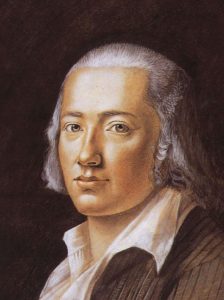
In the mid-19th century, Hölderlin’s work began to attract wider attention; later, his utopian ideals regarding German culture were appropriated by both leftists and Nazis. Eisler’s approach to setting Hölderlin was to fragment the selected poems, extracting only evocative images of home, both pleasant and disturbing, and bypassing any grandiose or mythic visions of a German state that smacked of nationalism, in essence exiling the lines from their source and using them to assemble a delicate mosaic of memories.
A lilting melody, reminiscent of a waltz, opens An eine Stadt, caressing the words “loveliest city of the Fatherland.” The piano interlude repeats the vocal melody, extending and expanding the gentle mood at first, but just as it is dying away, erupts into loud, staccato repeated chords. With its new, wide-ranging melody and aggressive accents, this drastic contrast befits the following verse, which describes birds and people in flight. Return to the opening section accompanies a calmer memory of the city viewed from the distance, only to be interrupted again by another agitated passage depicting the wanderer looking back toward the shore from turbulent waters. Again, the memory of happy streets, cool gardens, and restful shade emerges with the final return of the opening melody and heartfelt piano postlude, only to be shattered by the violence of the final chord. No pleasing memory can be allowed to persist.
Selections from Songs on Texts by Kurt Tucholsky (1959-61)
Heute zwischen gestern und morgen (Today Between Yesterday and Tomorrow)
Einigkeit und Recht und Freiheit (Unity and Justice and Freedom)
Journalist, critic, and writer of satirical verse Kurt Tucholsky (1890-1935) lived and worked in Berlin during the early 1920s, immersed in leftist politics and pursuing an agenda of socialist and anti-war activism through his literary efforts. He moved to Paris in 1924 and then to Sweden in 1929. In 1933 he was stripped of German citizenship by the Nazis, who burned his books; in 1935 he took his own life. Despite Tucholsky’s departure from Berlin in 1924, just before Eisler arrived in 1925, Eisler knew the writer’s work well. In their political aims and goals for social progress, the two were kindred spirits from the start. Tucholsky was an active contributor to German leftist and communist journals and anthologies through 1933. Besides reviews, stories, and essays, he wrote ballads and poetry decrying militarism and the oppression of the working class, many of which were set to music and performed widely in Berlin at both political gatherings and in cabarets.

In 1930 Eisler had set one of Tucholsky’s poems, “Bourgeois Charity,” as a ballad for men’s chorus and small orchestra. An excerpt from the text of this ballad illustrates Tucholsky’s fierce proletarian point of view: “They hand you down plenty of alms with pious Christian prayers; they tend the suffering woman in childbirth, for they certainly need the workers…Money in thousands and thousands has poured into foreign pockets; the dividends have been decided by the board of directors. For you the broth, for them the Mark.”
Upon his return to Berlin in 1950, Eisler’s hopes for the creation of a new artistic culture in the nascent socialist state of East Germany directed his compositional efforts toward what he called “applied music” – theatre works, cinema scores, cabaret songs, educational materials, and pieces for public events. Such music should fulfill social needs for relevant, honest subject matter, straightforwardness of expression, and simplicity, avoiding high-flown language, excess of emotion, and harmonic complexity. Out of this long-term project came the collection of 36 songs that Eisler wrote to Tucholsky’s poetry, two of which appear on this program.
Both songs exemplify the ideal characteristics of “applied music” in cabaret style: their texts employ the verse-chorus format of popular song and address social conditions in a sardonic manner. The repetitive, easily singable melodies underscore the clear rhyme schemes and rhythmic accents of the words. The piano accompaniments are simple and chordal, designed to support the singer and enhance the intelligibility of the words. The songs avoid dissonance and don’t distract the listener with introductions, interludes, or postludes, instead supplying an ironic commentary on the sorry state of affairs with their insistence on the major key and their jaunty, dance-like textures.
Vierzehn Arten den Regen zu beschreiben/Fourteen Ways of describing Rain, Op. 70 (1941)
Eisler’s chamber music production was sparse. His work in the genre was restricted to two specific times in his creative life: the years of study with Schoenberg (1923-25), and the years of exile in America (1938-47). During the other times, he directed his energies outside the concert hall: to film music, pedagogical materials, large- and small-scale pieces for political causes and the workers’ struggle, and the theatre. Most interesting are the frequent interconnections in Eisler’s output between his film music and his chamber music. The quintet and the Septet on tonight’s program both began their lives as film projects.
Eisler first collaborated in 1932 with Dutch documentary filmmaker Joris Ivens, whose many pictures explored leftist social and political issues. Ivens pioneered silent film and introduced techniques like montage and juxtaposition of abstract images. He lived long enough to document the Vietnam War and life in China after the Cultural Revolution, infusing social awareness and his particular point of view into every frame.
Eisler and Ivens’ last project together was Fourteen Ways of Describing Rain. Ivens’s 1929 silent picture was of the type called “city symphony.” It is an exploration of a rainstorm in Amsterdam, filmed over many months and carefully assembled. The film documents the first drops on the canal to the downpour on cars, streets, umbrellas, and skylights, and the final drizzle on the same canal. Ivens described its organization as musical, with the recurring image of the canal serving as a refrain that ties together the different stages of the storm with its shifting rhythms of raindrops and people. Eisler created a detailed study of the film as well as a score, which became the foundation of his book Composing for the Films. He composed his score as a set of fourteen tightly organized and continuous variations based on a 12-tone row for flute, clarinet, violin/viola, cello, and piano.
Eisler posited that such unique instrumentation, with its varied tonal colors, could help synchronize with details and provide strong contrast, freeing the music from the need to imitate or follow along with the film. Thus, creating an emotional distance between sound and image enabled him to portray fourteen ways of being sad (symbolized by the rain) with “dignity and decency.” The variations range in length from short to very short; glittering winds, sweeping gestures, trills and tremolos, and energetic rhythmic ostinatos combine in a series of ever-changing textures, and the piece concludes with sweeping upward arpeggios as if looking up to the sky to see if the storm has cleared.
The “Rain” quintet is widely considered Eisler’s most important chamber work. He dedicated it to his teacher, Arnold Schoenberg, and presented it to him in 1944 for Schoenberg’s 70th birthday. The quintet was performed at a February 1948 Town Hall concert of Eisler’s music organized by Leonard Bernstein, Aaron Copland, and other prominent musicians to honor him as he faced deportation.
Septet No. 2 “Zirkus”/“Circus” (1947)
Hanns Eisler met Charlie Chaplin at a Hollywood party in 1942; they soon became fast friends and socialized regularly. Each was attracted to the other’s wit, brilliance, and creativity. In 1946, Chaplin engaged Eisler as a music adviser for his latest film project, Monsieur Verdoux. While Eisler was skeptical about the potential of this arrangement, writing to a mutual friend of his frustration with Chaplin’s “very rudimentary” ideas about music, he nevertheless participated out of friendship. However, when Chaplin proposed in 1947 to reissue his 1928 silent film “The Circus” with a new score, which Eisler would compose, Eisler accepted and set to work on the project.

Unfortunately, the collaboration was thwarted when a House Un-American Activities Committee interrogation put an end to Eisler’s career in America. Eisler was accused of being a Communist agent by HUAC and was expelled from the U.S. in 1948. Prominent artists and intellectuals, including Chaplin, Einstein, and Picasso, protested HUAC’s decision, but to no avail. (Chaplin himself would soon be under investigation as a Communist sympathizer, and after traveling to England in 1952 to promote his film Limelight, he was barred from re-entering the U.S. by J. Edgar Hoover.)
Still, Eisler was able to salvage his work on “The Circus” by adapting the sketches for his film score into Septet No. 2 for string quartet, flute/piccolo, clarinet, and bassoon, using the same instrumentation he had employed for his previous Septet from 1940 (also the fruits of a film project). Both Septets were performed at the Town Hall concert in February 1948. But the “Circus” Septet proved to be Eisler’s final chamber music work. After Eisler returned to East Germany and resumed composing, he never again wrote in any concert music genre, choosing to devote himself to “applied music” that conveyed an explicit political message and fulfilled a social purpose.
The six movements of the “Circus” Septet seem to portray Eisler’s hope, stated in a lecture given in Prague in May 1948, that following the victory over fascism, music might be able to promote a higher form of society, moving past the times of trouble and torment to express a “friendly and more joyful character.” At once, this piece communicates exuberance and optimism with its extravagant abundance of melodies, new ones tumbling over each other throughout the course of each movement. The music never seems to rest, and the wind instruments especially engage in acrobatic runs, trills, leaps, and other athletic displays. The players participate in a kaleidoscope of constantly changing textures whose configurations are elegantly choreographed in alternating moments of soloistic virtuosity. It is as well-balanced and thrilling as any acrobatic stunt!
Ernste Gesänge/Serious Songs (1961-62)
We return again to song, as Eisler did at the end of his life with this cycle, his final composition, completed only weeks before he died. He began it in early 1961 as a response to Nikita Kruschev’s shocking revelation of Joseph Stalin’s purges and abuses in a speech to the Twentieth Congress of the Communist Party of the Soviet Union in 1956. One of the songs in this set even bears the blunt title “Twentieth Party Congress.” Eisler’s pain at this stain on socialist ideals was exacerbated by the death of Brecht, heightening tension in divided Germany, the construction of the Berlin Wall, and his own illness. He explained the cycle as the experience of “reflection – deliberation – depression – recovery – and reflection again…In concrete situations, you must describe the ups and downs.” Significantly, he relies on excerpts from Hölderlin, the poet of longing and hope, for the majority of the texts, along with single selections by Helmut Richter, Giacomo Leopardi, Berthold Viertel, and Stephan Hermlin. Although not formally modeled on Brahms’s late Four Serious Songs, which were written in anticipation of Clara Schumann’s death, Eisler’s Serious Songs share Brahms’s aura of melancholy reflection.
Eisler’s songs combine declamatory and lyrical vocal passages, demanding an athletic and rich vocalism and dialogue between the voice and instrumental parts. The melancholy contrapuntal prelude establishes no tonal foundation and is interrupted by the singer’s strident pronouncement that sorrowful speech is to follow. With “Refuge,” the cycle proper commences; the singer ruminates on the dying gardens of autumn with an introspective but wandering melodic line, which the piano supports with sustained chords.
The second song, “Sadness,” opens like a slow elegy but, with the voice’s entrance, transforms into a sweetly lyrical ballad that embraces its own sorrow. It is followed by “Despair,” a brief and angry explosion that suddenly dispels the subdued feeling of the previous songs. “To Hope” paradoxically continues the furious mood with another intense outburst by the singer. The nervous, percussive “20th Party Congress” emphasizes the insistent questioning of the “party line” that will bring out the truth at last, fulfilling the hope to live without fear.
The final song, “Come into the Open, Friend,” presents a hesitant lyricism, pausing between lines and repeating brief melodic fragments. This leads directly to the singer’s earnest plea, underpinned by almost frantic accompaniment, in the cycle’s Epilog, that happiness arrives “certainly, certainly…” But the Epilog simply stops, rather than ends, leaving the matter open.
We can offer no stronger praise of Eisler’s final composition than that proclaimed by German composer Heiner Goebbels, who wrote Eislermaterial, an homage to Eisler which was performed at Lincoln Center in 2003: “That’s the great thing about Eisler. He doesn’t exclude feelings. He includes doubts and aggressions, hopes and fears – he includes everything. Perhaps that’s why these [melancholy] songs allow most of the truth to come through. Because they don’t pretend just to be powerful, to have no doubts – they’re full of everything.”