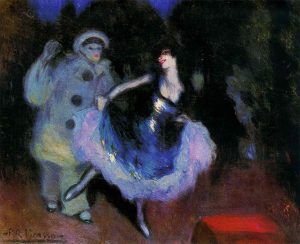
In Guarneri Hall, audience members eagerly take their places; on the program is a landmark of 20th-century music. A small, odd collection of instrumentalists resembling no standard chamber ensemble and a reciter who will neither speak nor sing are about to present the disjointed and lurid tale of a bumbling, timeworn stock character drawn from 16th-century Italian improvisational theater tradition. Tonight’s event is none other than Arnold Schoenberg’s Pierrot lunaire, one of the most fascinating and influential compositions by one of the most significant and original figures in the history of music.
Moonstruck Pierrot, by turns silly and malicious! Arnold Schoenberg, the modernist innovator who would through expressive intent and intellectual effort transform the language of music, saw in the image of this white-faced clown the condition of the modern artist: a sensitive, imaginative being, isolated, ridiculed, and abused, searching desperately for a way to communicate after the old rules and conventional means have failed. Although his pathetic disguise offers no protection from the anxieties and absurdity of existence, Schoenberg’s Pierrot doggedly pursues his vision, fumbling his way through a broken world. As Schoenberg wrote in 1910, “Art is the cry not of those who avert their eyes to protect themselves from emotion, but of those who open them wide to tackle what has to be tackled.”
Schoenberg and Modernism
The modernist movement in which Schoenberg played such a vital role arose in the late 19th century and reached its peak after World War I, sparked by the all-encompassing political, scientific, economic, and societal shifts in the world that followed the Industrial Revolution. Global capitalism and advanced industrialization altered the structures of society; Darwin, Nietzsche, Marx, Freud, Röntgen, Whitehead, and Einstein upended people’s understanding of history, physiology, psychology, science, and philosophy. With so many scientific discoveries and technological innovations taking place, tradition could no longer be relied upon, and the old assumptions lost their relevance. Artists and people in general felt alienated from the world around them. Culture writ large had to be re-envisioned so that it could thrive in modernity.

Modernism’s concerns infiltrated literature, theater, music, visual art, and philosophy. The rejection of prior aesthetic values, the old notions of perfect form, beauty, and truth, paved the way for bursts of experimentation with new materials, subjects, techniques, and processes in every field. Yet grounding this questioning was an undercurrent of confidence in progress, a belief that we could learn how to be new in a new world. This belief would bolster creative artists when their experiments faced derision and rejection. Of his artistic journey during the first decade of the 20th century, Schoenberg recalled, “I had had to fight for every new work; I had been offended in the most outrageous manner by criticism; I had lost friends and I had completely lost my belief in the judgment of friends… but I believed I had found my own personal style of composing… and I knew I had the duty of developing my ideas for the sake of progress in music whether I liked it or not.” And in 1912 it was Pierrot Lunaire that finally changed the situation and brought Schoenberg success in his new style.
Early Struggles
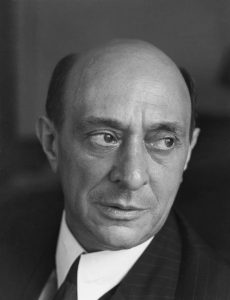
Arnold Schoenberg was born on September 13, 1874 in Vienna. His family was far from affluent. His parents could not afford music lessons to nurture his obvious talent, and he attended vocational school rather than the elite Gymnasium, which prepared students for university. When his father died of influenza in 1889, young Schoenberg had to leave school to support the family. The cessation of his education left a lasting mark on his personality. Despite working full time as a bank clerk, he pursued the acquisition of knowledge on his own and remained proud, even arrogant, about his status as a self-taught intellectual and life-long learner. He maintained his musical efforts by composing, playing the violin and teaching himself the cello. Attending concerts, playing in amateur bands, and learning music theory enabled him to participate in Viennese musical culture. By 1893 he had learned enough to embark upon a few months of study with composer Alexander Zemlinsky, who became his friend, brother-in-law, and the only teacher he ever had. Schoenberg’s biographer Bojan Bujiç noted, “The speed with which he imbibed knowledge and the breadth of the musical repertory with which he became familiar through the analysis of scores were evidently phenomenal.” Music’s hold on him grew, and in 1895 when he lost his bank job, he happily declared that he was now able to become a professional musician.
Schoenberg continued to compose, receiving a concert performance of an early string quartet and publishing three sets of songs. He began teaching and working as a choral director and arranger. With his 1899 string sextet Verklärte Nacht (Transfigured Night, Op. 4), based on a poem by Richard Dehmel, he broke new ground musically but also earned his first public condemnation. At the piece’s premiere in 1902, the work’s programmatic content and complex textures and harmonies met with critics’ hostility and caused fistfights among the audience. In 1901 he married Zemlinsky’s sister Mathilde and moved to Berlin to conduct and arrange for Überbrettl,the new literary cabaret at the Buntes Theater. There he embarked upon two large-scale projects, the oratorio Gurrelieder and the symphonic poem Pelleas und Melisande. Although Schoenberg did not achieve financial success in Berlin and returned to Vienna in 1903, he had made important publishing contacts and established himself within the more accepting Berlin musical community.
Back in Vienna, Schoenberg was embraced by a progressive group interested in promoting contemporary music, poetry, and drama: the Ansorge Society. Supported by Gustav Mahler, Schoenberg and Zemlinsky founded their own Society of Creative Musicians in 1904. In the same year the two opened an informal conservatoire where Schoenberg began to develop his pedagogical philosophy of rigorous analysis and thorough study of Bach, Mozart, Beethoven, Schubert, Brahms, Wagner, Mahler, Reger, and other “old masters,” grounding students like Anton Webern and Alban Berg in the language and logic of a musical tradition whose mastery would enable them to evolve their own modes of expression, just as he had. New directions in his own work emerged in the First String Quartet, Op. 7 (1905), and the Chamber Symphony, Op. 9 (1906), single-movement pieces in which shorter motifs and phrases are so extensively reshaped and varied that they lose tonal definition and acquire new identities through an evolutionary process. Critical response to both was harsh: after their performances in 1907 the quartet was described as “an unholy scandal” and Op. 9 was mocked as the “Chamber-of-Horrors Symphony.” Thus began a period of compositional searching, exacerbated by personal crisis, which would last for four years.
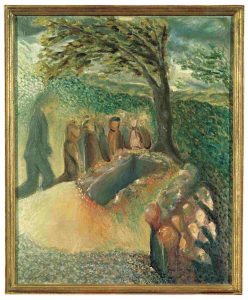
With two children and a marriage that was becoming troubled, the pressure intensified on Schoenberg to provide for his family, ever more difficult in the face of opposition to his music. He composed several sets of songs and took up painting to explore new modes of expression. Richard Gerstl, a painter whom he had befriended, gave both Schoenbergs instruction in brushwork techniques and took a studio near their home. Mathilde and Arnold grew further estranged; in summer 1908 she abandoned her family to live with Gerstl. After a few months Mathilde returned home and the affair came to a gruesome end when Gerstl committed suicide. During this period Schoenberg was occupied with a new composition which further transformed his style and which he identified as a breakthrough: the Second String Quartet, Op. 10, dedicated to his wife, in four thematically-related movements. A soprano joins the quartet for the last two movements, incorporating poetry by Stefan George. Significantly, the third movement opens with the words “Deep is the sadness that engulfs me,” and the finale, which has no key signature, sets the poem “I feel the air from other planets” – a fascinating merger of personal and professional concerns.
A Turning Point
However, despite the derision that again greeted his new quartet at its premiere, Schoenberg believed that he had discovered “ways of building and carrying out understandable, characteristic, original, and expressive themes and melodies” outside the traditional harmonic system, and over the next several years his creative activity intensified. He took what he called his “first decisive step” of renouncing a tonal center in the song cycle The Book of the Hanging Gardens, Op. 15 (1908-9) and the Three Piano Pieces, Op. 11 (1909). The remarkable monodrama Erwartung (Expectation, Op. 17) of 1909 uses an unconventional text narrating the nightmare of a woman in trauma, eschewing repetition of themes and clearly delineated sections in favor of the continuous development of short motivic gestures in a manner often described as stream-of-consciousness. His next project was also for the theater: the drama with music Die glückliche Hand (The Lucky Hand, Op. 18), begun in 1910 and completed in 1913, for solo singer, chorus, and several silent actors. For this work Schoenberg was poet, stage/lighting designer, and composer. But he would submit neither of those two stage works for performance and by this point despaired of ever earning a living from composing. So in 1910 he began writing a book on the theory of harmony.
This treatise, Harmonielehre, proved a turning point in Schoenberg’s fortunes. Published in 1911 and dedicated “to the hallowed memory of Gustav Mahler,” Harmonielehre earned him widespread respect and established his reputation as a music theorist. The book does not advocate for Schoenberg’s compositional approach but rather explains the principles of harmonic practice from Bach to around 1900, displaying his prodigious knowledge of tonal music to demonstrate the constant evolution of harmonic language. Another auspicious development quickly followed: the commission in January 1912 to compose music for the poetic cycle Pierrot lunaire, which would provide Schoenberg with renewed compositional vigor and an artistic triumph.
Pierrot was a tremendous success. At the first performance on October 16, 1912 in Berlin, the audience cheered and demanded an immediate encore. During the remainder of 1912, fifteen additional performances were given throughout Germany, the Netherlands, and Russia and were received just as positively, with fellow composers Puccini and Busoni expressing their enthusiasm. Schoenberg now enjoyed praise on an international level and found himself in demand.
Pierrot’s impact on subsequent musical activity is undeniable. Among American composers and performers alone, it has been immediate and lasting. Henry Cowell and Charles Griffes both knew the score and wrote works inspired by Pierrot in 1915 and 1917, respectively. The American premiere in 1923 made fans out of Carl Ruggles, George Gershwin and Otto Leuning. By the early 1930s, the piece had been performed in the major American cities with the involvement of prominent figures like Aaron Copland and Marc Blitzstein. Musicologist Sabine Feisst notes that after World War II, Pierrot was widely acknowledged as a significant source of inspiration for new American chamber music: “Composers like Milton Babbitt, John Harbison, Joan Tower, George Crumb, and Pauline Oliveros to name a few made no secret of their debt to Schoenberg’s groundbreaking cycle, evidenced as homage, parody, quotations, and allusions to the work’s instrumentation, vocal treatment, structure, and theatricality.” Lukas Foss declared in 1975, “Our new music roughly begins with Pierrot lunaire.” Its effects resonate even today in works by contemporary composers Michael Torke and Robert Paterson. The observation that New York Times critic Olin Downes made in 1940 still rings true: Pierrot is powerfully expressive, and despite everything that has happened in music since 1912, it still sounds strikingly modern.
Schoenberg ended his days in America. As a Jew, he knew in 1933 that after the Nazis rose to power his life and livelihood were in peril, so he emigrated to the U.S., starting out in Boston but within a year settling in Los Angeles. There he enjoyed rich friendships and a new crop of devoted pupils, as well as performances and recordings of his music. But his health was never robust. After a near-fatal heart attack in 1946, he grew gradually weaker. Having been born on the unlucky 13th day, he feared turning 76 (7+6=13), and became convinced he would die on Friday, July 13, 1951. That day, depressed, he remained in bed; he awakened at 11:45pm hoping that he was out of danger, but a few moments later collapsed. He died at age 76, 13 minutes before midnight. Schoenberg’s death certificate lists his occupation as “composer of modern music.” It was all he ever wanted to be.
Setting Giraud’s Poetry to Music
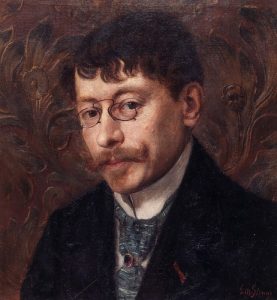
Pierrot lunaire: Rondels bergamasques (Moonstruck Pierrot: Rondels from Bergamo) is a collection of 50 poems written in 1884 by Belgian poet Albert Giraud. In Symbolist fashion, Giraud employs suggestive language to create imaginative spaces through the vehicle of the commedia characters. Actress Albertine Zehme had been presenting recitations of Otto Erich Hartleben’s German versions of the French poems accompanied by Otto Vrieslander’s music, but she found that music inadequate and it was she who approached Schoenberg with the commission. Attracted by the idea, Schoenberg selected 21 from the 1911 edition of the set and settled on the full title Dreimal sieben Gedichte aus Albert Girauds Pierrot lunaire (Three Times Seven Poems from Albert Giraud’s Pierrot lunaire). The name “Pierrot” contains 7 letters, and the work would be published as his Op. 21. These coincidences pleased him; Schoenberg was a lifelong believer in numerology and the number 7 possesses great mystical and spiritual significance. He began composing on March 12, 1912, and by July had completed the set. In organizing his cycle, Schoenberg constructed both a dramatic scenario and a unique sound-world, both contributing to what he called the “extreme novelty” that led to the work’s success.
Texts and Timeline
In Giraud’s Pierrot, the rondel form of each poem entails 13 lines in 3 groups (4 + 4 + 5), in which the first 2 lines of the 1st group are also the last 2 lines of the 2nd group, with the 1st line of the poem serving as the final line. This formal circularity creates both continuity through regular returns and confusion by placing certain lines in three different contexts almost simultaneously. Schoenberg does not alter Giraud’s poems by repetition or omission of lines or words. However, he creates a narrative that does not exist in the original by reordering the poems into a chronological order. Shoenberg’s three groups of seven take place during moonrise, deep night, and the first glimmers of dawn. He further organizes each group of seven thematically: the first introduces the three main characters; the second portrays Pierrot as a violent, threatening, and blasphemous figure; while the third shows us Pierrot as inept, slapstick, or sad. Each group has an additional structural element. Part 1 is a palindrome: songs 1, 4, and 7 are about the moon, songs 2 and 6 about the female persona, and 3 and 5 the male persona. In Part 2, religious imagery dominates through many references to blood, the mass, and sacrifice, while Pierrot is made a saint, a grave-robber, a Satanic priest, and a martyr. Part 3 opens with Pierrot longing for home and closes as he sets out on his journey there.
But apart from these elements, the narrative is disjunct and ambiguous. Many events seem hallucinatory and unhinged from reality. The poet referred to may or may not be Pierrot; the old woman and the Madonna may or may not be Colombine. The moon is intoxicating and gentle, but also sick, threatening, and irritating. Schoenberg viewed these poems as “light and ironic, without pathos,” juxtaposing the macabre and the foolish, as if calling attention to the perversities of human existence and the ineffectiveness of human agency. It is this satiric perspective itself that seems to provide an overarching unity of viewpoint.
Sprechstimme
The bizarre mode of vocal production that Schoenberg employs, somewhere between recitation and singing, has various names: Sprechmelodie (speech-melody); Sprechgesang (speech-song); and the most familiar one, Sprechstimme (speech-voice). The pitches of the vocal part appear in tiny notes but are not to be sung. Schoenberg’s clear instructions to the vocalist bear repeating: adhere to the notated rhythms precisely as if singing, but simply approximate the shape and pitches of the melody without actually singing. His goal is not realistic, natural, or singsong speech: it is a stylized speech that “collaborates in a musical form.” This vocalization is the most salient aspect of the piece and a truly revolutionary device. Here Schoenberg’s experience working in the Berlin cabaret appears relevant; precise, even harsh diction and a nuanced, half-sung delivery characterize the performance style of the cabaret performers which was imported from France to Germany. Its arresting vocal color and texture reinforce the strange atmosphere of the texts.
Instrumentation and Tone Color
Schoenberg settled on an ensemble of five musicians playing eight instruments: piano, violin doubling viola, cello, flute doubling piccolo, and clarinet doubling bass clarinet. This provided a great variety of sound resources as he never used the same combination twice in the same way. The constantly changing array of instrumental colors reinforces the mood of each poem and provides both atmosphere and contrast. The dark tones of the bass clarinet, cello, and piano in low register reveal the ominous and oppressive night of #8, after the solo flute feebly portrays the sick moon of #7. The form of a poem may even be delineated by tone color, as in #3 “The Dandy.” The sparkling moonbeams and splashing water in Pierrot’s washbasin, expressed by the dancing piccolo, clarinet, and piano, grow quiet when Pierrot finally sits down at his dressing table to decide how to make up his face. At that point the piccolo and clarinet fade out from the texture while the piano repeats the same chord for 5 bars as if Pierrot taps his fingers, lost in thought. With his decision, the chord disappears; the winds re-enter with a flourish as he selects the moonbeam for his face. –
Pantonality.
“If people speak of me,” wrote Schoenberg in 1948, “they at once connect me with horror, with atonality and composition with 12 tones.” But Schoenberg saw no reason for musicians to be forced to use tonality to express themselves or to be horrified when they did not. Tonality is the technique of establishing - and the feeling of being in – a key through the ordering of harmonies in certain sequences and the careful control of pitches. When coloristic and dissonant sonorities had become common in musical language, as they had by the late 19th century, the functional ability of tonality to provide structure and control relationships among harmonies was enervated. The more remote a harmony is from the home key, the more prevalent such harmonies are in the musical texture, and the greater the amount of dissonance, the weaker the cohesive power of the tonal center. This Schoenberg perceived to be the natural evolution of musical practice.
The approach Schoenberg devised as the next step in this evolutionary path enabled him to do away with the structural obligation of tonality. Schoenberg preferred the term “pantonal” to signify that all tones relate to one another, and Pierrot lunaire, like his other works composed between 1908 and the early 1920s, falls into this style. He used pitches in all imaginable combinations and in any order. Consequently, none of the songs has a single tonal point of reference, a “home key.” Phrases are no longer required to balance by beginning and ending in a certain way. Dissonance, the feeling of “wrong” or discordant pitches, is in Schoenberg’s word “emancipated” – a discordant pitch is not required to become consonant but is free to coexist with any tones it is combined with.
However, Schoenberg remains concerned about musical logic and form. We still need to perceive Initiation, continuation, and conclusion to understand his ideas. One of the ways he achieves this is the use of short, highly distinctive ideas. As the first song opens, for example, we hear a 7-note (!) melodic gesture in the piano four times in a row. Recognizing repetitions or similar versions of this gesture throughout the piece helps us get our bearings and provides a sense of opening or closure. Changes of texture and figuration also serve to define sections. Imitation and dialogue offer yet another way of following the musical logic. Change of pace is important as well; slowly moving passages that suddenly or gradually incorporate more activity convey shifts of mood and intensity. All these techniques are used to lend coherence to tonal music too. As Schoenberg might say, his music still behaves like music; it just isn’t contained within a key.
Part I. We Meet the Characters: The Moon, Colombine, and Pierrot
1. Moondrunk
Brilliant moonlight, as intoxicating as wine, pours down upon the poet. The cello melody announces the tipsy poet who appears in the third stanza.
2. Colombine
The moonlight appears as blossoming roses in this rapturous waltz.
3. The Dandy
Pierrot prepares to paint his face; the musical motion stalls as he considers the options and then erupts excitedly when he selects the white moonbeam.
4. Laundress Moon
The subdued image of moonbeams as pale arms rinsing faded linen is conveyed by pale tone colors, soft dynamic levels, and slow-moving chords.
5. Valse de Chopin
Another waltz, this one delirious and repetitive, accompanies “wild chords of passion” in an appropriately frenzied scene.
6. Madonna
Deliberate, intertwining melodies reminiscent of Baroque polyphony open this invocation to the holy Mother. With the sight of her son’s body at the end, the piano cries out in agony.
7. The Sick Moon
The flute wails dramatically as the embodiment of the sick and dying moon.
Part II. Pierrot: Diabolical and Demented
8. Night
The image of monstrous black moths calls up this strange soundscape: a low, slow passage in the piano opens the song, against the cello and bass clarinet. Its oppressive repetition evokes obsession and night terrors. The entire piece descends to deep, dark registers.
9. Prayer to Pierrot
Here the focus is on the singer, who is instructed to hiss and sing, and cannot escape the low register, to emphasize that laughter has been forgotten.
10. Theft
Eerie sound colors in strings, flute, and clarinet emphasize the ghastly image of rubies as drops of blood on a coffin. Rhythmically and registrally they become almost hysterical in the third stanza – “scared to death.”
11. Red Mass
Pierrot celebrates mass, displaying his bleeding heart as a communion offering. In this song, the centerpiece of the cycle, each verse has a different character and sound. The opening of the mass is ceremonial, with piano trills and flourishes. The second verse is more tumultuous as Pierrot rends his garments. For the closing communion, ceremony returns; the bass clarinet intones a weird chant over an echo of the opening piano gesture.
12. Gallows Song
The shortest song in the cycle passes in a flash, perhaps like the image of Pierrot’s life just before he meets his demise on the fantasized gallows.
13. Beheading
Pierrot hallucinates that the moon is a giant sword swooping down to cut off his head. Increasingly dense textures of intertwining instrumental lines evoke his agitated, feverish thoughts and growing terror, culminating in a violent scream.
14. The Crosses
An instrumental interlude based on #7 The Sick Moon precedes #14, a reprise of the end of Part I that offers a brief respite before the violence of #14, in which the poet is crucified upon his verses. Its extreme dynamic levels, tremendously loud in the first two verses, hushed in the third, but ending with two loud abrupt thumps, might be Schoenberg’s parody of the overly dramatic, hypersensitive fin-de-siècle poet.
Part III. Pierrot: Hapless and Homesick
15. Homesickness
Pierrot longs for home. The piano’s opening figure and the violin’s and clarinet’s high registers encapsulate his “crystal sigh.” The unusually long introduction, interludes, and postlude imply his wordless sorrow.
16. Foul Play
In this sarcastic waltz, Pierrot makes fun of Cassander’s bald head. We hear his malicious giggle over and over as a group of 5 repeated pitches. First it is sotto voce in the cello but eventually all the instruments burst into laughter.
17. Parody
Moonbeams tease an old woman by imitating the knitting needles stuck in her hair while the piano pounds out a polka. Pairs of instruments imitate each other like two knitting needles clicking in rhythm; the voice employs whining sounds at the words “she loves Pierrot so much it hurts.”
18. The Moon Spot
Pierrot mistakes a spot of moonlight on the back of his jacket for a dab of white paint and, turning around, tries in vain to rub it off. Accordingly, this song is a palindrome; at the point the singer mentions the white spot, the instruments begin a restatement of their parts in reverse order.
19. Serenade
This langorous waltz features the cello in an elaborate and florid solo; Pierrot wails on his instrument to the growing annoyance of Cassander, who is chastened in the final stanza as Pierrot draws his bow across Cassander’s head.
20. Journey Home
Here the barcarolle’s rocking motion conveys Pierrot homeward in a boat whose rudder is a moonbeam. The clarinet introduces the lyric voice which it passes to the piano in stanza 2, only to recapture its heartfelt melody in the postlude.
21. O Ancient Fragrance
The only song to use all 8 instruments, this lovely piece celebrates Pierrot’s happy return in simple song-style. Never before have the voice and the accompaniment been so closely coordinated or so free of agitation. Schoenberg periodically touches upon major chords, though not in any functional sense, as if to say, “Once upon a time, there was tonality…” Is Pierrot’s homecoming only a dream?d just to be powerful, to have no doubts – they’re full of everything.”