
Torn between a desire for freedom of musical expression and the responsibilities of his role as a cultural ambassador for the Soviet Union, Shostakovich often found himself caught in the space between laughter and tears. Much of his work explores the line between ironic self-expression and deeply felt tragedy. This irony often manifests in musical details, such as overly exaggerated dynamics, rhythms and textures, or through the use of melodies that call back to either his own previous work or the work of other well-known composers.
Musical irony is deeply idiomatic to Shostakovich’s compositional style. In my view it often manifests within the framework of Jewish existential irony, a viewpoint that is hopeful by nature but also self-aware. While Shostakovich himself was not Jewish, he was surrounded by Russian Jews throughout his life and maintained close relationships that undoubtedly influenced his personal philosophy and world view.
The Jewish ethos comes from a Jewish mode of awareness of existence, one in which an inescapable human responsibility becomes to expect justice in a hopelessly unjust world.
Jewish Existential Irony
One idiom through which we can begin to understand Jewish existential irony is through the archetype of Tevye the milkman. As explored by Sholem Aleichem’s classic tale “Fiddler on the Roof,” the Jewish people have occupied a precariousness throughout history. In conversations with God, Tevye expresses the irony of the Jewish existence, addressing the “compassionate and merciful God” while simultaneously enduring His all-powerful justice. As musicologist Esti Sheinberg explores: “In spite of his failed existential query for justice, there is no trace of Russian nihilism in the Jewish milkman’s attitude: weighed down by fatal blows, Tevye (whose name means ‘the goodness of God’), uses the Jewish ethos to transfigure his suffering into a special kind of existential philosophy: Jewish irony.”
Irony itself can manifest as either stimulus or terminus. When manifesting as stimulus, irony is primarily used to satirize. It presumes that both the messenger and the recipient are aware of and share the same value systems and communication codes, thus providing the means for the reconstruction of the covert or “real” message that the messenger wanted to communicate. This system of communication between the messenger and the recipient is valuable as shared culture and education facilitate the communication of the unsaid, one of the potential avenues through which existential irony can serve as resistance.
When manifesting as terminus, irony becomes more complex. This type of irony rejects norms, values and cultures and often has less to do with aesthetics and more to do with ethics. As a result, an additional layer of nuance is added when considering the manifestation of annihilation within this form of irony, more specifically expressions of self-annihilation, self-pity or self- depreciation. To put it more generally, when the messenger utilizes irony as a terminus, it is to negate or destroy some aspect of themselves or their communication as they relate to cultural norms, values and expectations. Therefore by applying a kind of Jewishness to himself through his application of musical idioms and philosophy, Shostakovich annihilates a part of himself to take on an otherness that helps him to resist political oppression.
An added layer of nuance to Shostakovich’s ironic musical idioms is the ways in which existential philosophy comes into play. Broadly speaking, existentialism deals with the human frustration of expecting congruity in an incongruous universe. While Western existentialism is very much occupied with ontological enquiries about existence, Russian existentialism is focused on morality and ethics. As a result, building on existential philosophy, the core of the Jewish ethos doesn’t view existential issues and incongruences as symbols of a nihilistic or meaningless human life, but rather, they see the irony in human suffering and in particular the suffering that we bring upon ourselves.
Unfortunately, Shostakovich knew a thing or two about suffering. Throughout his life, he was faced with not only censorship but also threats to the livelihoods of himself, his friends, and his family members. As a result, perhaps Shostakovich connected with Jewish existential irony and he may have found some solace in this worldview at particularly difficult moments throughout his life.
Lifelong Difficulties
In June 1960, Shostakovich found himself in Leningrad, where he suffered an emotional breakdown, brought on by the prospect of an imminent convocation in Moscow to set in motion his initiation as a Party member, bringing with it heavy moral questioning and feelings of existential dread. After returning from Dresden in the middle of June, Shostakovich quietly completed Satires for soprano and piano, setting five poems by the turn of the century poet Sasha Chorny. The poems sarcastically point out the foolishness of blindly following and embracing the hysteria of post-revolutionary ideas.
The title of the work, Satires: Pictures of the Past, also displays irony in the face of cultural oppression.While officials may have assumed that Satires was intended to satirize the pre-Soviet revolutionary past, in reality they very much commented on the present. As the great Russian soprano Galina Vishnevskaya recalls, it was her idea to add a subtitle to the song cycle: Pictures of the Past. With the new title, the hope was that the authorities would see the set as a satire of imperialist Russia before the Communist revolution. However, the composer and performers alike hoped that the public would be able to see through the misdirection, and this subtitle furthers the ironic existence of the piece as it can be viewed from both the perspective of the official and the common listener. Perhaps Shostakovich could see the application of Chorny’s poetry to his own ironic situation and the personal suffering he faced throughout his life. By expressing the unsaid through ironic musical elements and signifying Russia’s imperialist past through quotation of Rachmaninoff, Shostakovich found avenues through which to critic the oppressive environment he found himself in, and perhaps finding some existential relief along the way.
Satires
So, how does this irony manifest itself in Shostakovich’s music? Three primary elements emerge: incongruities, ambiguity, and exaggeration – in which incongruous metric implications, ambiguous harmonic functions, and exaggerated musical clichés nuance and challenge established compositional norms.
Focusing specifically on the second piece of Satires, “Spring Awakening” we see manifestations of Jewish existential irony within the text and musical material. Existential irony implies a heightened emotional state and, as discussed previously, indicates a kind of self deprecation or even self annihilation that is expressed through ironic musical gestures that feature emotional exaggeration, existential questioning and laughter at one’s own suffering.
The overall form of the piece presents itself in a rondo-like fashion, with a repeated refrain and contrasting episodes indicating a kind of ABACA pattern. Instances of musical irony and existential inquiry throughout the piece are underscored by the composer’s use of quotation and signification of the past through the use of Rachmaninoff’s well-known art song “Spring Waters,” to which the A sections are closely tied. This signification of the past further enhances Shostakovich’s otherness, resisting against the oppressor through the unsaid understanding of cultural knowledge.
Rachmaninoff: “Spring Waters” (the material that Shostakovich quotes in the A section)
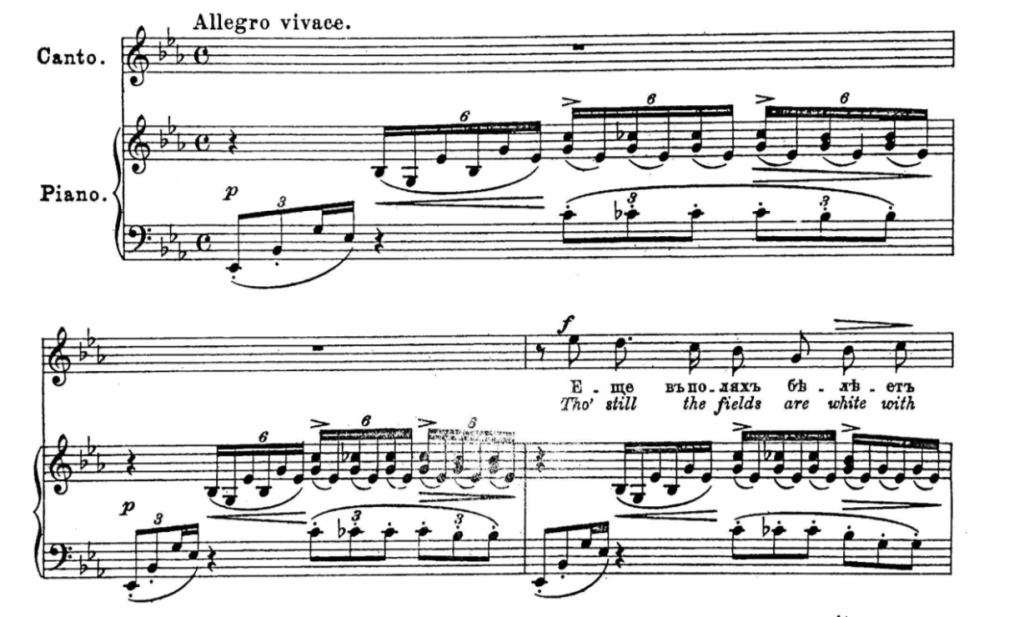
Shostakovich: “Spring Awakening” A Section

The opening melody, seen above, within the piano accompaniment is repeated throughout the piece, returning in various iterations but always within the opening key of F major. This motivic repetition calls upon the audience to constantly recall a familiar melody from a composer and piece that would’ve been an essential part of a generation’s cultural education. Signification of Rachmaninoff and implied understanding through meta-knowledge, becomes a means of calling back to the imperialist past in order to resist the communist present.
The contrasting sections B and C indicate mood shifts that heighten the emotions of the piece through ironic musical gestures. The B section features instances of incongruity, ambiguity and exaggeration. As the section progresses, these musical elements create a forward momentum that ultimately leads to the realization of musical irony. As a result, each appearance of incongruity, ambiguity and exaggeration inform moments of irony that are underscored by the quotation of Rachmaninoff’s “Spring Waters” in the piano accompaniment of the returning refrain. Each time the irony is realized, we see the return of the Rachmaninoff quotation.
Uniquely, the C section features an instance of realism, indicating a more overt criticism of Soviet society. This section differs from all others as the harmony becomes intensely atonal and the meter shifts from 4/4 to a more unstable 3/2. The texture of the piano accompaniment becomes more intense and tumultuous, abandoning the humorous, lilting quotation of Rachmaninoff that are featured throughout the A sections of the piece.
Sasha Chorny’s text is also set intentionally, with the text shifting from an esoteric and heightened state of awareness in the opening to a more literal representation of reality. This is seen in the realism section with lyrics such as, “but for many there is nothing, as in the winter there is nothing to eat. The trees are expectant, the water is stagnant, and there are more drunks around than ever.” The text goes on to beg the all powerful creator for relief, thanking them for bringing the spring. This segment sees the performer of the song speaking directly to an all-knowing and just Creator, reminiscent of the conversations with God that Tevye the milkman has as he comes to terms with God’s mercy and his all-powerful justice. This text contrasts heavily with the opening lyrics of the piece that reflect the more light-hearted and lilting piano accompaniment. The opening text reads: “Yesterday my cat glanced at the calendar, instantly raised his tail like a trumpet, then raced out onto the stairs, as in the old days and started yelling loudly and lasciviously, ‘spring marriages, common law marriages! quickly, all the cats to the attic!’” The next verse goes on to describe a cactus coming back from the dead like a new Lazarus flooded with tea leaves and coffee grounds.
Turning now to a closer look at how some of these musical features of irony present themselves throughout the piece, a representative example of ironic incongruity is seen in the following excerpt from measures 36 to 41:
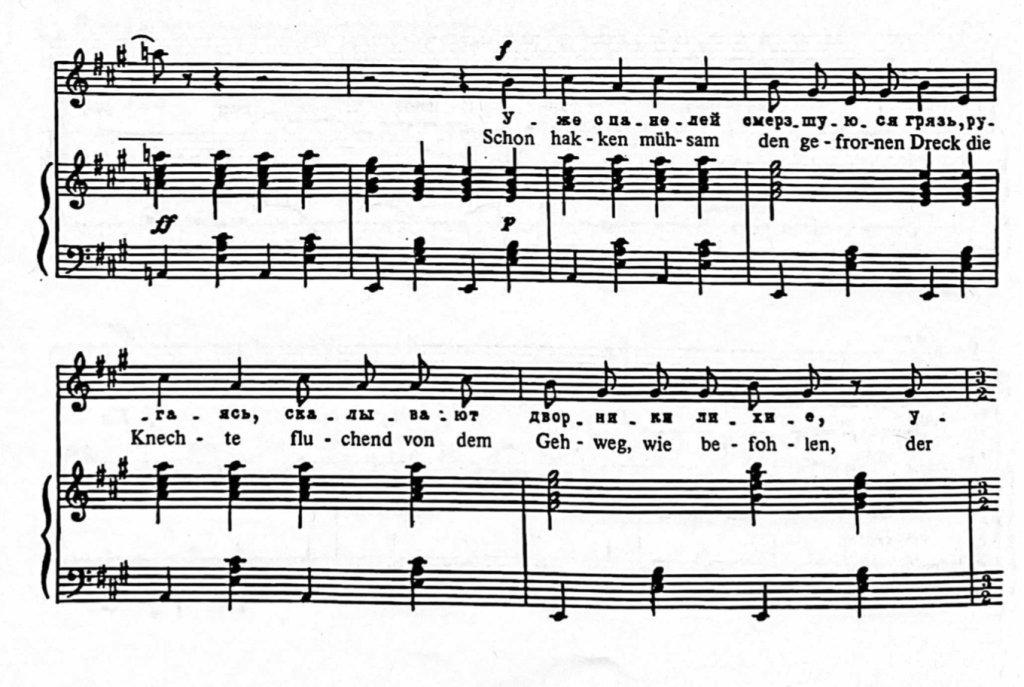
Here we see metric incongruities that juxtapose the mode and timbre of the previous musical material. This section is in cut time, with the accompaniment implying a march-like quality in duple meter. This type of rhythm could perhaps signify pride or even patriotism, but because of the harsh articulations and sudden textural change in the piano accompaniment, the section takes on a sarcastic tone. Musical irony is additionally implied through the incongruity between this section and the rest of the piece as well as exaggerations in timbre, texture and dynamics. Following the sarcastic march, a representative example of ambiguity is seen in the section immediately following, from measures 42-45. The meter suddenly changes to 3/2 and the clear tonality of A major seen in the previous section is suddenly traded for a tonally ambiguous accompaniment and vocal line:

This ambiguity implies a musical irony as the piece continues to indicate A major, while clearly meandering between tonalities every couple beats. The vocal line is particularly interesting in regard to ambiguity because it sits in the middle of the soprano range and moves by half steps. As a result, the singer must be especially conscious of their breath engagement and onsets, otherwise they risk the pitches falling flat and perhaps adding an additional layer of ambiguity to the section. There’s additional humor implied by the descending nature of the vocal line, as it sounds like a simple chromatic sigh while indicating a necessary virtuosity from the singer.
Finding Solace
Through the lens of these frameworks, Satires reveals two avenues through which Shostakovich resisted Soviet cultural oppression: his use of Jewish existential philosophy through ironic musical gestures, and his signification of the past through quotation of Rachmaninoff. By referring to Russian imperialism, Shostakovich directly criticized anti-cosmopolitanism, as the Romantic era implies certain values and aesthetics that explore and value the nature of the human condition. Signification of the past becomes resistance to the repressive present and, utilizing ironic musical gestures based in Jewish existential philosophy, he “others” himself in order to resist against an oppressive collectivity. This otherness falls into the category of the unsaid but implied, leading to a liminality in which this resistance can live and be tolerated.
Faced with countless difficulties throughout his life, Dmitri Shostakovich had to be particularly creative in his artistic expression. Laden with criticism, public humiliation, and threats to his life, somehow his music continued to carry a thread of ironic humor even in his most overtly tragic works. Perhaps, Shostakovich’s idiomatic humor was defined by Jewish existential irony, as he learned from those around him that one can easily laugh just as one can cry at the injustices of life.
Guarneri Hall’s concert on November 8th, 2024, features Shostakovich’s song cycle Satires: Pictures of the Past, an under-performed work that exemplifies the composer’s ironic compositional style.