
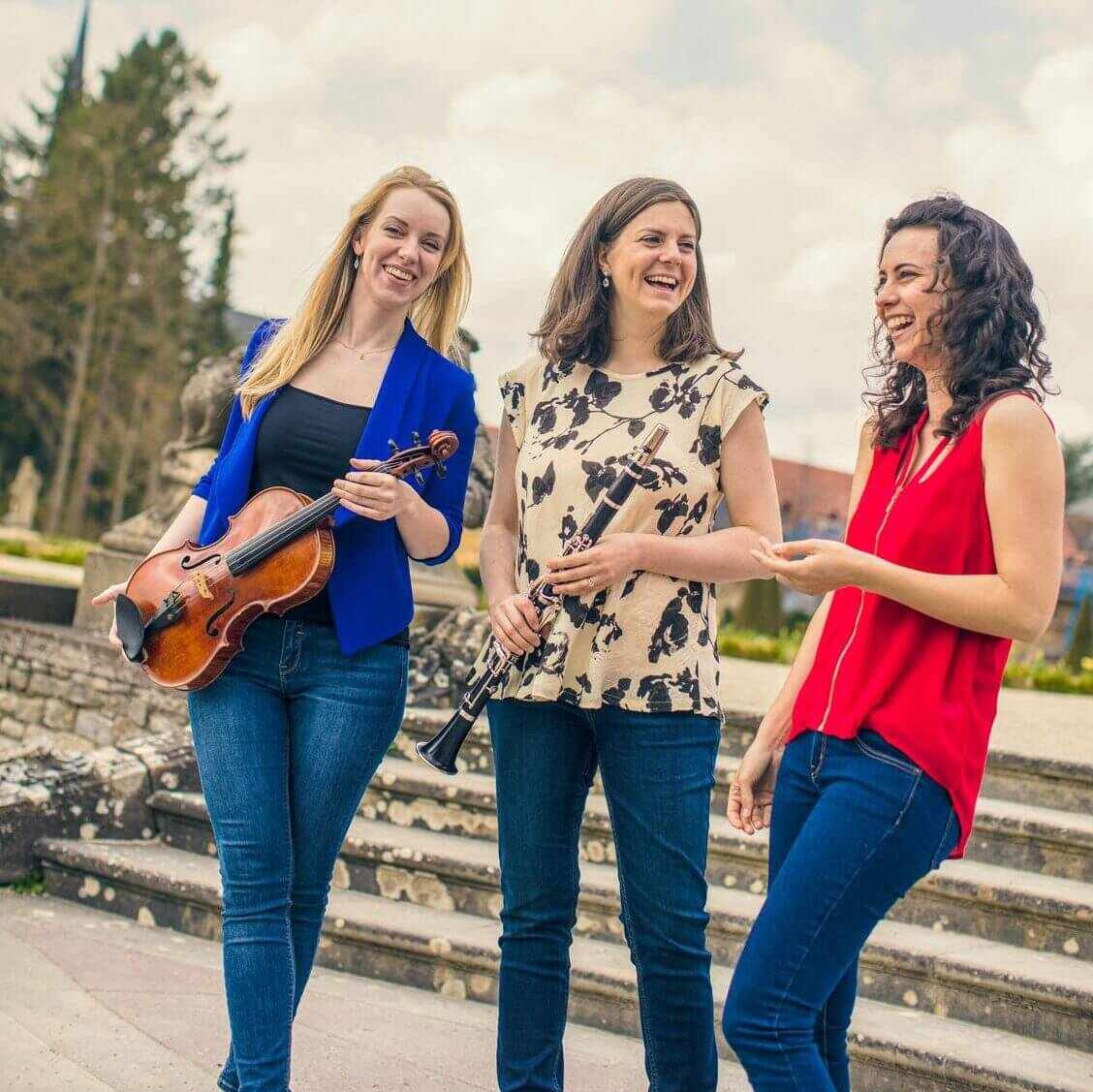
The award-winning Iris Trio brings its innovative and critically acclaimed Project Earth to Guarneri Hall on April 22 and 23, 2026, in celebration of Earth Day. Trio members Christine Carter, clarinet, Zoë Martin Doike, viola, and Anna Petrova, piano, conceived the project as their artistic response to the environmental crises facing our planet. Weaving together contemporary poetry with original and eclectic music that combines classical, jazz, folk, and world music genres, Project Earth evokes the beauty and vitality of the natural world, as well as pathos in its elegies for the creatures and lands we have lost. Project Earth consists of two parts: its “Blue Chapter” draws inspiration from the nesting bird species inhabiting the islands around the Newfoundland coast; “Green Chapter” pays homage to the incredible life of trees and explores the dwindling of prairie habitats.
I was happy to talk with Zoë Martin-Doike, the Iris Trio’s violist, about their upcoming performances at Guarneri Hall.
LINDA BERNA: We’re so excited that Project Earth is finally coming to fruition here! Could you share a little about how this project came about?
ZOË MARTIN-DOIKE: Anna and Christine formed the Iris Trio in 2013 with the original violist, Molly Carr, while they were conservatory students living in New York City. They really loved playing together and started the chamber ensemble so they could continue working as a group after graduating. The trio had some successful performances in North America and Europe and was really gaining momentum, releasing their debut album, when the pandemic hit in 2020. And that’s actually when Project Earth was born. I joined the trio in 2022, after playing two residencies with Anna and Christine. We felt an immediate artistic and personal kinship. But I have to say that Project Earth was one of the reasons I was so enthusiastic about joining the trio because it was something I really wanted to be a part of in terms of my artistic voice and purpose.
LINDA: Was there an incident, or moment, or flash of realization that galvanized the creation of Project Earth? The pandemic was traumatic and changed so many things, but it did force people to reflect upon their values and priorities.
ZOË: I have heard Christine say that a major catalyst for her during this time was that she had become a mother. Obviously what’s happening to the environment has been in the forefront of our minds for many decades now. But having children made the dangers more urgent for her: what is the world we will leave for the young people who will survive us, and what is our own responsibility to protect our environment?
LINDA: I was in high school when the first Earth Day happened in 1970. It’s the only global cultural event uniting people in a common cause, to honor and protect our planet. Earth Day doesn’t just remind us that we are stewards of the earth, it also mobilizes people on a very small scale to very large scales to take action to address environmental crises. It’s a little daunting to me that after 56 years it can feel as if we are in more peril than ever. But we now understand the interdependence of ecosystems around the globe, and the quality of life for all species seems to be more of a meta-concern, so perhaps that is a positive evolution in the Earth Day movement.
ZOË: True, but we are still up against it in a really serious way.
LINDA: Something that interests me about the Iris Trio is the focus on interdisciplinary projects, going back to its participation in the 2014 documentary film MozartLabor exploring the creative process of preparing a new work for the Mozartfest Würzburg (Germany). Is this kind of work part of the ethos of your ensemble?
ZOË: Absolutely, and it’s been a big part of Project Earth. Commissioning poetry and new music, and interaction among musicians, composers, poets, and audio engineers for the performances and recordings, have brought the content to life in ways that are more meaningful than music alone could have accomplished.
I can also share that Project Earth is entering a new phase. We’re currently booking a tour in which we perform parts of the piece in partnership with a choreographer who heard our 2024 recording of Project Earth: The Blue Chapter and was so excited by it. She has worked very intricately with the music to express its themes through dance, and it really adds another dimension to the work.

LINDA: How did you connect with the collaborators you’ve been able to find — the composers, poets, and now dancers?
ZOË: Finding partnerships is largely spearheaded by Christine, drawing on relationships she has formed in other professional settings, and her overtures are always well received! For instance, she worked with our choreographer in another ensemble. She has secured great support from Canada’s Council for the Arts because we collaborate extensively with Canadian artists, and they helped fund our Blue Chapter recording on the Canadian Centrediscs label. Thanks to them we have the Green Chapter “in the can” and plan to release it this summer!
LINDA: Christine lives in Newfoundland where she is a professor at Memorial University’s school of music. Anna is based in Kentucky and holds a teaching position at the University of Louisville. You are in New York and are a tenured member of the Metropolitan Opera Orchestra. It must be a challenge for the three of you, so far-flung geographically, to keep things together and moving forward.
ZOË: We must plan very, very far in advance! But it’s always a joy to come together so it’s something that we prioritize fitting into our artistic and teaching lives.
LINDA: I would like to go back to something you said earlier about wanting to use your artistic voice. The conviction that you as an individual or an ensemble member have a voice to raise in service of a message or cause or some larger aspiration than just playing and enjoying music from an aesthetic point of view – is that something you developed in school, or did you come to it later in your professional life?
ZOË: I will say that in school, at the Curtis Institute of Music, I was always very interested in community engagement. We had some wonderful programs there that encouraged us in these ventures and provided many opportunities and funding to work on projects with communities. During that time, I also began to appreciate how much work goes into creating and implementing those projects! It’s so hard to do them effectively and I was able to start building my skill set in that area.
I think also that classical musicians really must grapple with the sense, whether it’s true or not, that the art form is no longer relevant. As I reckon with it myself, I find that promoting works of living composers and drawing inspiration from the world that I live in are the most meaningful things I could possibly do. I have always wanted that to play a part in my artistic life, and I feel very privileged that through my work at the Metropolitan Opera, I have a platform to be able to do so.
LINDA: Yes, you have the infrastructure and the potential to reach many people. You mentioned the enthusiastic responses the ensemble has enjoyed from other arts domains. What kinds of responses have you received from the scientific and environmental communities?
ZOË: That has also been extremely positive. Two Aprils ago we played several concerts in the New York City area, and one of our venues and partners was the New York City Climate Museum. Its founder and director, Miranda Massie, is committed to fostering community engagement and action on climate change by combining the forces of art, culture and science. She was thrilled to discover that Project Earth existed, because she wants people to engage with the scientific realities but not to feel overwhelmed by the data on climate change, species loss, and environmental degradation. Massie’s work focuses on shifting the conversation from a solely rational/scientific perspective to a more personal, emotional, and actionable one. When people’s hearts are affected, they start to care about the numbers and want to make a difference.

LINDA: That might be one of the advantages of using chamber music as a medium to reach people directly. Unlike the opera, it’s portable and flexible. Have you found that there are benefits to being a small group with a large message?
ZOË: Absolutely! Flexibility is really the key. Each time we present Project Earth it’s a little different, based on who we’re working with and where, especially if we are bringing in other disciplines. We had some performances in Canada where we worked with a local scientist who studied sea birds, and he brought everything to life for our piece called Bird Island Suite. It makes the work more meaningful for our audiences when we can incorporate people from their own community.
LINDA: There is a long history of composers responding to the beauty of nature through their music. Knowing that we can no longer take nature’s beauty for granted, do you think the process of engaging nature musically has changed?
ZOË: Absolutely. Our composers and poets for Project Earth do a wonderful job of capturing that sense of loss as well as beauty.
LINDA: Have you envisioned any more chapters for Project Earth?
ZOË: The trio always intended that there would be a third chapter and I’m thrilled because it will be the first in which I’ll be part of the planning process. The timeline will likely be longer, because we are still experimenting with and expanding the Blue and Green Chapters, for instance by adding the dance component I mentioned.
I’m very excited to bring my part of the world to Project Earth’s next chapter. I grew up in Honolulu, Hawaii, in the middle of the Pacific and quite remote from the mainland. I have a vivid sense of the impact humans have had on nature because we have experienced mass extinction of native species. At one time Hawaii had more biodiversity than the Galapagos, and so much of that is completely lost. The other crisis is rising sea levels. Many of the natural landmarks I knew as a child have disappeared, and now catastrophic flooding threatens the islands. So, these environmental issues are very personal to me.
LINDA: I’m hoping that the trio members will be speaking during the performances at Guarneri Hall, to help the audiences listen for particular and unusual sounds in the music and to explain the genesis of your artistic ideas.
ZOË: Yes, we love doing that! The intimacy of Guarneri Hall makes it the ideal place to present Project Earth, and it will be a very special experience for all of us. We can’t wait!