It’s impossible to overstate how much was lost to the music world when internationally renowned violin expert Charles Beare passed away in April of 2025. For over five decades, Charles was the world’s most respected authority on rare violins.
The field is shrouded in mystery; the classic Italian violins of the 16th, 17th, and 18th centuries are objects of both exquisite beauty and artistic utility that have defied all later attempts at replication. Expertise in classic violins requires an unusual and highly specific confluence of skills and experience. Aspirational attributions, hidden flaws, and clever forgeries have been around almost as long as the objects themselves, and can be perilously difficult to detect. The slightest misstep by an owner or dealer can result in dire consequences, financially and reputationally.
Charles’ sharp eye, vast and quick memory, historical knowledge, business instincts, and integrity were each benchmarks on their own. Together, they were a formidable package that made him singularly unimpeachable in the field and earned Charles broad respect from the trade, musicians, and collectors, making a Beare certificate of authenticity the gold standard for creating confidence in an attribution and resolving disputes in the market.
I first met Charles in 1979 at the old J & A Beare shop in London’s Soho neighborhood. Then and in the years afterwards, first at the shop on Queen Anne Street in the early 2000’s, then later in Kent after he’d left behind the company started by his forebears, I was privileged to witness Charles’ astounding abilities on a number of occasions. It was always interesting and edifying, and sometimes jaw-droppingly impressive.
On one trip, I arrived with two Stradivari violins that I was sure Charles had never seen before. One was the 1710 “Vieuxtemps” Stradivari, which had been in a bank vault in Seattle for many decades, out of circulation. Standing perhaps 20 feet away from me as I pulled the violin from its case, Charles immediately let out with, “Oh, that must be the one from Seattle.” In a matter of seconds, just from a glance at the top, he had worked out the maker and source of a violin he had never seen, but knew from reading old archives that it must have been in a vault in Seattle.
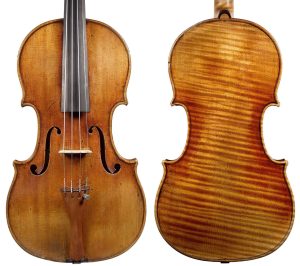
After spending some time admiring that violin, it was time to show him the next one: an Omobono Stradivari (one of the violin-maker sons of Antonio Stradivari) that had lain dormant in California since the 1940s. This time, Charles immediately identified the violin by maker and was sure that he remembered the violin from an earlier encounter. But how, I wondered? I knew the history of the violin and knew there was no way he ever could have laid eyes on it.
After some time, Charles excused himself to look for something and left the room for about 20 minutes. When he returned, he was carrying a copy of The Strad magazine from the 1950s containing a small, highly pixelated photo of the Omobono Stradivari violin in question. Somehow, he had remembered the violin from that photo and connected it with the violin I was showing him for the first time! That day was but one of a number of bewildering displays of Charles’ expertise that I was lucky enough to witness firsthand. These experiences might make it clear why I invariably felt a sense of anticipation going to see Charles, and a sense that it was over too soon as I left.
Despite the immense power that Charles wielded over the business, I always felt treated fairly and with equanimity by him. The late Robert Bein, who was the most highly regarded American expert of his day, once called Charles the “Michael Jordan” of violin expertise. I saw that, but I also saw a sense of kindness and decency in Charles that set him apart from others and made him a friend to so many musicians.
Charles’ legacy will live on in the large body of certificates, written opinions, articles, and books that he authored. But his absence leaves a gap with no clear heir apparent to serve as “the” global authority with comparable gravitas. The violin world will likely have to wait a long time for an expert of that stature and humanity to emerge. The world is poorer for his loss.