
Even though you’re only make believing
Laugh, clown, laugh!
Even though something inside is grieving
Laugh, clown, laugh!
Don’t let your heart grow too mellow
Just be a real punchinello, fellow
That song, with lyrics by Sam Lewis and Joe Young, was written for the eponymous 1928 film starring Lon Chaney. In the film, Chaney plays a lovelorn traveling circus clown named Tito who falls in love with his adopted daughter. Tragedy ensues. The song and the movie perfectly capture the character of Pierrot, the stock character from Commedia dell’arte, who has exerted a strange influence on everything from poetry to paintings, music to movies.
The Heartsick Clown of the 16th Century
Who can’t relate, at least a little bit, to the heartsick clown Pierrot? This character has his origins in 16th century Commedia dell’arte. With slapstick, stock characters in masks and broad humor, Commedia dell’arte delighted Europeans with its silliness. In Commedia, Pierrot was always the youngest character in the troupe, and instead of wearing a mask, he wore white powdered makeup and a white costume.
Pierrot became one of Commedia’s most sympathetic characters. Who can’t relate, at least a little bit, to the heartsick clown Pierrot? This character has his origins in 16th century Commedia dell’arte. With a heart as fragile as a lace Valentine, Pierrot would gently pursue the flirtatious servant girl Columbine, who, unfortunately for Pierrot, only had eyes for the charming and witty Harlequin.
From Commedia dell’arte to Chaplin

Commedia dell’arte had a profound and lasting impact on European culture. Pierrot even made his mark in the United States. Charlie Chaplin said that he conceived his “Little Tramp” character “as a sort of Pierrot.” Chaplin’s song “Smile” certainly captures that Pierrot spirit.
Smile, though your heart is aching
Smile, even though it’s breaking
When there are clouds in the sky
You’ll get by
If you smile
Boomers will remember the Rice Krispies commercial that used the aria ”Vesti la giubba” from the opera I Pagliacci, in which the lead character is a put-upon Pierrot figure. In the commercial, a father, with an anguished voice, sings that there are “No more Rice Krispies.” Pierrot would have been proud.
Still Breaking Bad
Pierrot, or a variation thereof, continues to show up in American pop culture. Stephen King’s 1986 horror novel It features a more sinister manifestation of the character in the sewer-dwelling clown Pennywise. In 2008, Pierrot broke bad again when he made an appearance in the Batman comics as Pierrot Lunaire, a non-speaking arch villain with impressive martial arts skills.

But Pierrot made much more of an impact in Europe. For example, Pierrot troupes, a uniquely British form of entertainment, performed at seaside resorts during the summer season. A group of men, decked out in traditional Pierrot clown costumes and makeup, performed three times daily, except on Sundays. The Pierrots would perform mime while accompanied by banjos and other noisemakers. Some say that the humor of Monty Python can be traced to the Pierrot troupes. The Pierrot troupes gradually faded away after World War II.
A French Affinity

There was something about Pierrot that was especially attractive to the French. Antoine Watteau painted one of the earliest and most iconic portraits of Pierrot in 1719. After the Revolution, the sad figure began to take on more complex meanings for French artists.
1825 to 1860 was known as the Golden Age of Pantomime in Paris. At the time, Cercle Funambulesque (Friends of the Funambules) was an extremely popular theatrical group dedicated to Commedia dell’arte. The company featured the highly-regarded actor Jean-Gaspard Deburau, who was known for his portrayal of Pierrot. French film director Marcel Carné tried to recreate his legendary Pierrot in the 1945 film Children of Paradise.
By the 1800s, Pierrot was enshrined as the heartsick clown. French Symbolist adaptations at the time made Pierrot more mystical. Sadness caused words to fail him, which is why he is considered the father of mime. The figure of Pierrot started to inspire what today we would call fan fiction.
More Than Meets the Eye

Writers started to imagine that behind Pierrot’s placid, inscrutable demeanor, lurked an angry, brooding character nearing the breaking point from endless romantic rejection.
Pierrot sceptique, (Pierrot the Sceptic) is a pantomime written in 1881 by the French decadent author Joris-Karl Huysmans and the novelist Léon Hennique. The authors made Pierrot by turns both joyful and violent. Theater historian Karl Toepfer refers to edgy Pierrot stories as “pantomime noir.”
A psychologically disturbed Pierrot was very appealing to absinthe-sipping, fin de siècle Europeans. It made Pierrot the perfect subject for Albert Giraud’s feverish poetic cycle, Pierrot lunaire. The poems are rich in meaning and address issues like materialism and the artist’s escape into his own inner world. They’re also a critical examination of romantic love and an exhortation to artists never to forget their art is sacred.
A Cornerstone of 20th Century Music
Arnold Schoenberg’s setting of Albert Giraud’s poetic cycle Pierrot lunaire stands as one of the greatest works inspired by Pierrot, and as a cornerstone of 20th century music. Besides Schoenberg, other composers have been inspired by Pierrot. Stravinsky’s Petrushka and Pulcinella owe a huge debt to the clown. Eight Songs for a Mad King is Peter Maxwell Davies retelling of Pierrot lunaire. Debussy wrote a lovely song about Pierrot
Pierrot was a favorite subject for painters, too. Paul Cézanne, Odilon Redon, Aubrey Beardsley, Salvador Dalí, Modigliani, Pablo Picasso and Paul Klee all made clown paintings of the highest order.
A Man of Mystery?
It’s odd that a seemingly vaporous character like Pierrot has had such a compelling influence on the arts. Maybe his appeal comes down to mystery. Who lurks underneath that big puffy clown suit and the white powder makeup? Friend or foe? A sensitive soul or a twisted psychopath? The mystery is magnetic. While Pierrot’s place in the popular zeitgeist has, for the time being, receded, his enigmatic spirit continues to represent the tortured romantic in all of us.
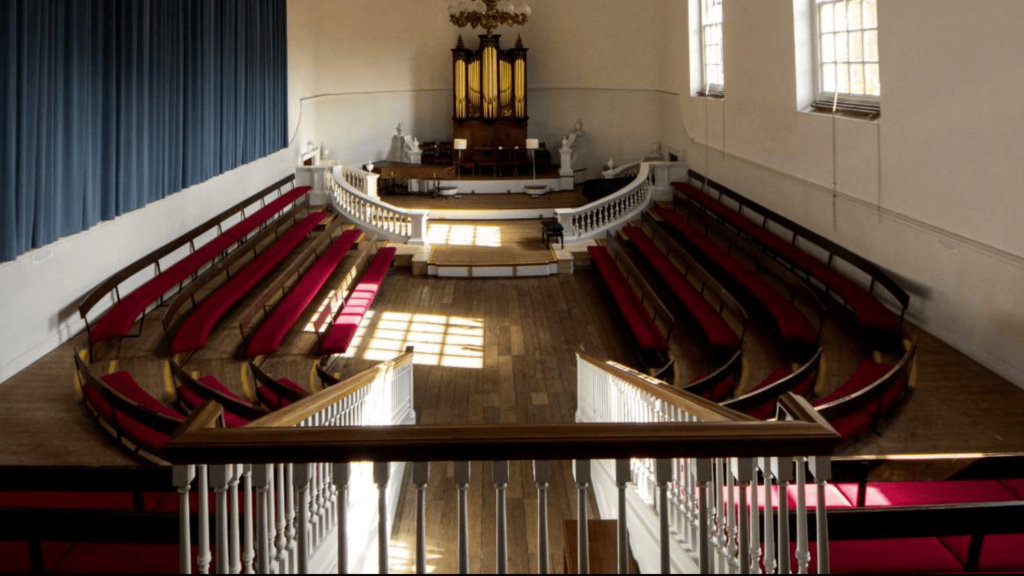
Guarneri Hall will present Arnold Schoenberg’s Pierrot lunaire on December 9 and 10, 2024, performed by soprano Kristina Bachrach and NEXUS Chamber Music.