
When French envoy Louis-Guillaume Otto coined the term “Industrial Revolution” in a 1799 diplomatic dispatch, he was describing the profound technological, economic, and social changes underway in France and spreading worldwide. What would come to be known as the First Industrial Revolution (c.1760 to 1840) was an avalanche of technological and logistical innovations that led to dramatic increases in manufacturing output and efficiency, ushering monumental social and political changes. Millions of people left their family farms for burgeoning urban communities centered around factories that provided jobs. A well-to-do middle class of industrialists and merchants emerged alongside an industrial working class. The Industrial Revolution transformed all aspects of society, including music.
A Musical Arms Race
The urbanization of the Industrial Revolution created demand for larger concert venues to serve the burgeoning cultural curiosity of affluent citizens. Any viable city was expected to build at least one large concert hall to accommodate audiences. Oxford’s pre-revolutionary Holywell Music Room, generally regarded as the first purpose-built concert hall in Europe, was built in 1748 with seating for 200. Vienna’s Großer Redoutensaal, also built in 1748, had a capacity of 700.
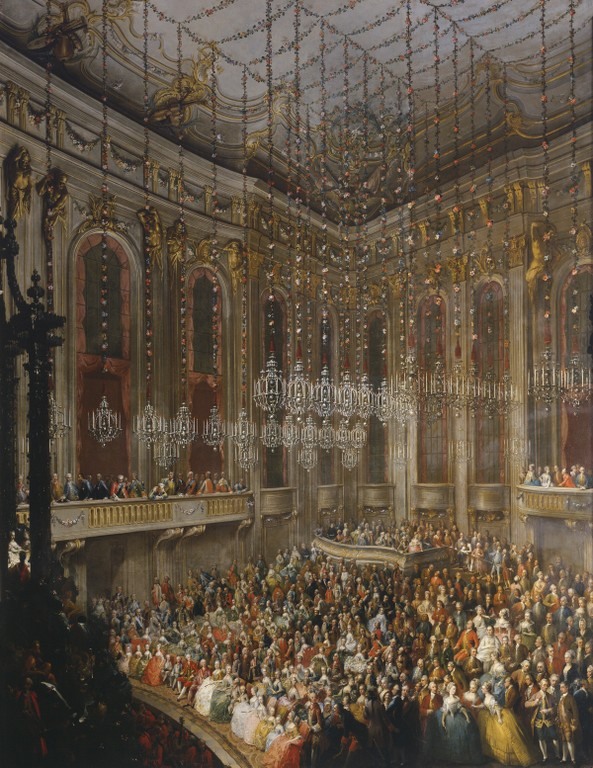
Leipzig’s Gewandhaus Hall had an original capacity of 500 in 1781, but was expanded in 1842 to hold up to 1000 patrons. In Paris, the Salle du Conservatoire opened in 1811 with a capacity of 1,000 seats. The trend toward bigger halls and grander spectacles would continue through the 19th century. With more acoustical space to fill, larger halls demanded larger ensembles performing on newly redesigned instruments that increasingly favored power over nuance. It was a dynamic time, with musical innovations fueling technological advances and innovations with instruments spurring artistic experimentation.
Beethoven’s melodic use of timpani in works like his Violin Concerto (1806) led directly to the development of advanced tuning mechanisms for timpani in the decades that followed. Heinrich Stölzel and Friedrich Blühmel’s 1818 patent for the box-piston valve revolutionized the chromatic capabilities of brass instruments. Valves transformed the French horn from a precarious natural instrument, for which the player had to swap parts to play in different keys, into a valved powerhouse that could reliably function in every key on demand. The modern tuba, made possible by this new technology, first appeared in early works by Richard Wagner in 1836 and was quickly adopted by others, anchoring the power of the modern brass section. Theobald Boehm’s revolutionary ring-key mechanism for flutes in the 1830s transformed the entire woodwind family. The early piano, invented around 1700 as a relatively soft, wooden-framed instrument, continued to gain volume and range as it evolved, until 1855, when Steinway set the modern standard for power and sonority by combining a full cast-iron plate with cross-stringing. Composers began to create works that took full advantage of these new developments, drawing ever larger and more powerful forces together. Concerts increasingly became grand events in large public spaces.
Strings and Bows
Meanwhile, Antonio Stradivari had already settled designs for modern string instruments from the 1690s on. His violins, violas, and cellos featured stronger arching and increased overall airspace, producing markedly greater volume and brilliance than the versions that preceded them. Stradivari and the makers who would follow produced violins of unprecedented power, well able to meet the demands of the larger venues to come. But bows of Stradivari’s time were lighter, shorter, and less stiff than modern bows. The emerging repertoire of the late 18th and early 19th century created demand for stronger bows that could produce more incisive attacks, brilliant articulation, and overall volume of sound than the bows of Stradivari’s time.
Toward the end of the 18th century, the Parisian craftsman Francois Xavier Tourte (1747-1835) began experimenting with modified violin, viola, and cello bows that were heavier, stiffer, longer, and more resilient than those that preceded them. Tourte’s revolutionary designs resulted in bows of much greater power than those that preceded them. This response to demand also facilitated future musical possibilities, and would ultimately establish the weights, dimensions, and design principles of modern bows that still endure today. There is no doubt that Tourte was the greatest bow maker ever, but misconceptions persist about the historical timing and nature of the transition to the modern bow.
The Greatest Violinist and the Greatest Bow Maker

In 1782, while Tourte was experimenting with the design of the bow, the legendary Italian violinist and composer Giovanni Battista Viotti (1755-1824) came to Paris and captivated the city with a sensational debut. He remained in France for the ten years that followed, just as the Industrial, French, and musical revolutions were starting to build momentum. Given their respective positions, the greatest violinist and greatest bow maker living in the same city at the same time, it seems likely that Viotti and Tourte would have known each other, but no firsthand account of a relationship between the two has come to light.
Despite the lack of supporting evidence, most histories of the development of the bow claim a collaborative relationship between Tourte and Viotti. Viotti, however, is known to have fled France in the summer of 1792 to avoid the political violence of the French Revolution. Therefore, the emergence of the modern bow has traditionally been ascribed to pre-1792, before Viotti’s departure. The record appears to contradict this timeline:
L’Art du Violon
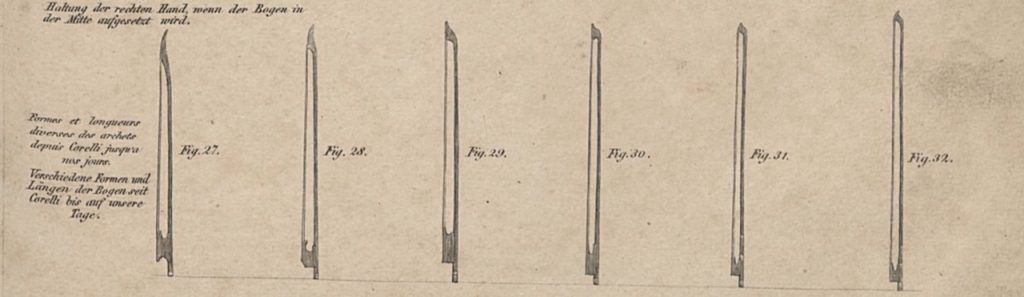
In his 1835 treatise L’Art du Violon, Pierre Baillot (1771-1842) characterizes the so-called “Viotti” bow as a transitional model, distinct from both the older “Cramer Head” design and the final Tourte version in use by most violinists by 1835. His precise language and direct knowledge of Viotti make Baillot a credible source, supporting the idea that the emergence of the modern bow occurred after, not before 1792. This would place the transition to the modern bow during the mid to late 1790s, just as Beethoven began to pave the way for Romanticism in music.
In 1795, Beethoven took his first public step as a composer with the publication of his three piano trios, Op. 1. The unusual darkness, dynamic contrast, and dramatic intensity of the trio Op. 1 #3 was unlike anything that had come before. Franz Joseph Haydn, the most esteemed composer of the day, had advised Beethoven against publishing Op. 1, No. 3 on the grounds that it would defy public comprehension. Beethoven published anyway, and the Op. 1 would prove to be his first big compositional success. Beethoven’s emerging powerful new style would serve as a model for composers to follow, and Tourte’s developed bow designs were well suited to the emerging dynamism of the Romantic era.
A Revolutionary Profusion
Evidence suggests that adoption of the Tourte bow did not occur overnight. Baillot confirms that the Tourte model was the standard by 1835, but its acceptance likely took decades as musicians and composers adapted to the new tool and to the increased dynamic range of the Romantic style.
The two bows illustrated below were made by the English maker, John Dodd I (1752-1839) in the mid-1790s. The frogs (which hold the hair at the lower end of the stick) are so close in form and finish that they could have been made within days of one another.

The head on the top example is of the Cramer design, whereas the second example is a fully modern type of head. These two bows, apparently made around the same time, are evidence of the contemporaneous competition between old and new designs for the violin bow.
In the mid-1790s, amid the transition, Viotti was onstage in London alongside Wilhelm Cramer, after whom the “Cramer Head” design is named. In performances at the 700-seat Hannover Square Rooms in London, Franz Joseph Haydn conducted his own symphonies. The orchestral musicians, led by Cramer, would have been using a profusion of traditional bows and other instruments alongside Viotti, as soloist, with a transitional bow, closer in form to its modern counterpart.
Hector Berlioz’s Symphonie Fantastique – written only three years after Beethoven’s death – was premiered in 1830 by an orchestra of 130 musicians playing to an audience of 1000 in the Salle du Conservatoire in Paris. Music had been utterly transformed from the strictures of the Classical style into the grand scale and intense emotion of Romanticism. The passion of the Romantic style, along with larger orchestras, bigger halls, and the Tourte bow, had together won the revolution.