The nine piano sonatas of Sergei Prokofiev (1891-1953), which span the entire course of his creative activity from his youth up to his final year, are widely considered one of the most significant bodies of piano music composed in the twentieth century. They are monumental in their physical demands upon the pianist, dazzling in the brilliance and variety of their sound worlds, and deeply expressive of human struggle, resilience, and passion. These sonatas speak in Prokofiev’s unmistakable musical voice; they embody his evolving artistic goals but also bear the imprint of his tumultuous life and times. Thus, each sonata will be contextualized in the program notes by the personal and historical circumstances that nurtured and colored it.
September 22, 2026: Freedom and Irony
Here was wretchedness; there life brimming over. Here, slaughter and barbaric rhetoric; there, cultivated life. Here, shabby concerts in Kislovodsk; there, New York, Chicago! No time for hesitation.
Sonata No. 3 in A Minor (from Old Notebooks), Op. 28 (1917)
Sonata No. 4 in C Minor (from Old Notebooks), Op. 29 (1917)
The years between Sergei Prokofiev’s 1914 graduation from the St. Petersburg Conservatory and his May 1918 departure from his native land in search of artistic success constitute a time of creative expansion and high productivity. He had concluded his student career with a triumph by capturing the Conservatory’s Rubinstein Prize. The contest, in which the school’s five best pianists played a concerto of their choice for a panel of 20 faculty, earned the winner a grand piano and a concerto performance with orchestra at the graduation ceremony. Determined to showcase his dual identity as a composer-pianist, Prokofiev made the controversial decision to compete with his own First Piano Concerto, which he had already premiered professionally outside of school, and was awarded a sensational victory over the objections of the traditionalist Conservatory director Alexander Glazunov.
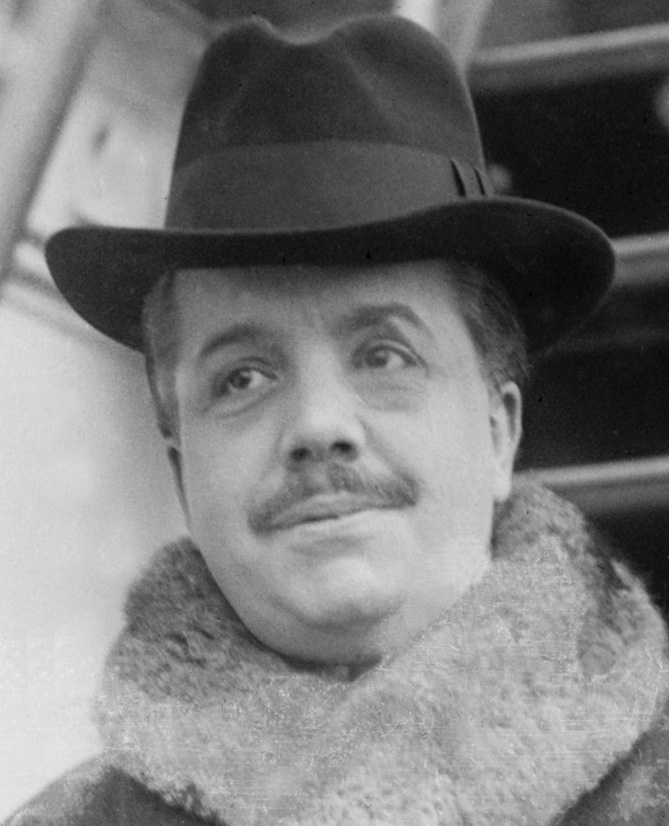
Prokofiev’s mother presented him with a trip abroad as a graduation reward, and the ambitious young composer chose London as his destination. Prokofiev hoped to make some connections there; he had seen the Ballets Russes perform in Paris the previous year and knew its founder, Sergei Diaghilev, to be a brilliant entrepreneur, central to the most progressive developments in contemporary art. Aware that Diaghilev’s company was in residence in London in the summer of 1914, he arranged to meet the famed impresario in the hopes of securing a commission. The plan worked. Diaghilev responded positively upon hearing Prokofiev play his Second Piano Concerto and directed him to work with the poet Sergey Gorodetsky back in St. Petersburg to develop a ballet on a Russian historical theme.
The following spring, Prokofiev shared sketches for this ballet, titled Ala and Lolli, with Diaghilev, but the latter was not satisfied and rejected it. Nevertheless, Diaghilev remained a champion of Prokofiev’s music and commissioned four more ballets from him. Three of them (The Buffoon,1921; The Steel Step, 1927; The Prodigal Son, 1929) were critical successes and laid the groundwork for the great narrative ballets Prokofiev would compose after returning to the U.S.S.R.: Romeo and Juliet, Cinderella, and The Stone Flower.
Work on the ballet projectsreinforced for Prokofiev the need to develop his skill as an orchestrator. Recasting music from Ala and Lolli in 1915 as an orchestral piece, Scythian Suite, was the first step in this direction; audiences were astounded at the suite’s 1916 premiere by the contrast between the massive orchestral sounds from the expanded brass and percussion sections and the delicate textures of its crystal-clear soloistic passages.
Prokofiev spent the summer of 1917 at a country house near Petrograd. The house had no piano, so he challenged himself to learn to compose without relying on that instrument. He felt that an orchestral sound would be more natural and colorful if the thematic materials did not originate at the keyboard, so he worked out a symphony in his head while on walks in the country, a symphony whose brevity and lightness would evoke the spirit of Haydn but that would sound fresh and new. He titled it his “Classical” Symphony; its premiere in April 1918 was a huge success and it remains one of his most beloved works.
As World War I raged on and St. Petersburg was under attack by the Germans in the autumn of 1917, Prokofiev was stuck in Kislovodsk in the Caucasus where he had gone to stay with his mother. There he learned of the October 1917 revolution: “The news was exciting but so contradictory that it was impossible to make out what was happening. I decided to go from Kislovodsk to Petrograd [St. Petersburg], although it seemed unlikely that my recitals of the Third and Fourth Sonatas could take place. A train with smashed windows arrived and a panic-stricken bourgeois crowd poured out, telling of shooting in the streets of Moscow. Indeed, this was hardly the time for concerts.”
Prokofiev based his Third Sonata on a one-movement piece written when he was a student in 1907. Feeling that the earlier work was not brilliant and virtuosic enough, he revised it in the Spring of 1917 to include more elaborate and difficult piano writing. He also continued his approach from the second sonata of juxtaposing strong contrasts in mood and character. Prokofiev premiered the sonata on April 15, 1918, in Petrograd; he dedicated it to Boris Verin, a close friend whose poetry he had set in his Op. 23 songs for voice and piano.
Prokofiev marks the opening of this brilliant piece “fast and stormy.” Loud, hammered chords and a bold, sharply accented fanfare, propelled underneath by constant triplets and an inner voice that snakes downward, introduce the main theme. The theme has two parts, a bouncy melody that skips up to the high register followed by a dry, mysterious version of the opening fanfare. Obsessive triplets underneath a version of the snaky inner-voice melody, now played by the two hands in opposition, one rising, the other descending, increase the tension as we transition into the second theme, a tender song marked “smooth and tranquil” that yearns upward repeatedly before relaxing and quietly closing.
The middle section restores the fierce mood with a furious scale passage that expands to the upper and lower registers and breaks into a reprise of the opening fanfare. Machine-like chords and arpeggios alternate with the opening notes of the main theme, angry and percussive. After the music briefly stalls on repeated chords under an oscillating figure, a nervous version of the lyrical second theme bursts forth. This theme transforms into a loud and passionate outcry. It dominates the remainder of the section with sweeping gestures, dense chords, and mighty octaves until it is abruptly cut off.
A motoric circular motive in triplet rhythm, intensifying in speed and energy, propels us through the transitional materials from the first section of the piece directly into a dramatic and extensive coda. A sequence based on a jagged motif from the transition gives way to a jaunty theme that seems too trivial for the stormy music that came before. But suddenly a militaristic march derived from the second lyrical theme emerges from the low register and builds relentlessly to the closing climax.
Prokofiev’s Sonata No. 4 originated from student compositions: a symphonic movement and a piano sonata. It was completed in Kislovodsk in the autumn of 1917 and comprises three movements, the first two somber and serious and the third brilliant and sparkling in the style of his “Classical” Symphony. Prokofiev premiered it on April 17, 1918, in Petrograd and dedicated it to his dear friend Maximilian Schmidthof, who had died by suicide in 1913.
The first movement’s main theme, a mysterious dirge, reluctantly emerges from the muddy-sounding low register. Its repetitive construction and irregular groupings obscure the sense of strong and weak beats, giving it an uncertain air. As it closes, sharp exclamations alternate with a quick four-note fragment that appeared in the dirge to transition to the second theme. Here the left hand’s bass line creeps around in the low register against wide leaps decorated by rapid flourishes in the right hand. Steady chords and octaves draw the opening section to a surprisingly decisive conclusion. In the middle section, themes, motifs and textures of the opening section reappear in jumbled order: first the main theme, next the closing material, then the main and second theme combined, to which is added the transition theme. The music grows louder as each element is layered on, until a sudden hushed arpeggio leads to spare octaves, which thicken into chords and whose aggressive dotted rhythms bring on the section’s violent climax. The restatement of the opening section offers no relief, only restoration of the ambiguous, uneasy atmosphere. The coda builds insistently to a loud cadence, then cuts off the movement rudely.
The second movement also begins in the gloomy low register. Plodding chords accompany a theme that creeps upward and then falls back before its loud, brusque cadence. Two variations of the theme appear, the melody in successively higher registers and with more elaborate arpeggiated textures. An anguished outburst of repeated chords, trills, and octaves interrupts but subsides almost immediately, making way for a serene lullaby whose melody floats down from the high register and comes to rest over a quietly pulsating accompaniment. The main theme reappears, surrounded by delicate arpeggios, but the anguished outburst disrupts it again, its rumbling trills exploding into a massive dissonant chord. The tempo then relaxes as the main theme and the lullaby theme merge, enveloped in repeated chords and octaves reminiscent of an incantation, and fade out delicately.
With a sparkling run up the keyboard, the last movement’s vigorous dance bursts forth with a jaunty melody and whirling left-hand accompaniment. The hands switch functions for the transition to the second theme, the left hand taking the staccato melody under the right hand’s arpeggios. The second theme is comically awkward, with jerky rhythms and a buzzing undercurrent. With a flourish, the dance theme returns and thumps to a stop. After an extended, tender lyrical episode, the last part of the dance theme makes a surprise entrance, softly at first as if sneaking in but growing more insistent. A snippet of the middle section melody precedes a headlong rush to the coda, which recapitulates the initial run four times, each one longer and higher, exploding into the dance’s electrifying finish.
Sonata No. 7 in B-flat Major, Op. 83 (1939-42)
My main job in Tbilisi was to complete the opera War and Peace. I had to write the scene of the Russian people’s struggle, their sufferings, wrath and courage and their ultimate victory over the enemy who invaded their country.
Prokofiev waited anxiously as World War I dragged on and civil war erupted. By then he had concluded that “Russia had no use for music,” and resolved to try his chances in America. In March 1918, when it became safe to leave the Caucasus, he went to Moscow to secure permission to travel abroad, which was granted by the Ministry of Education. He arrived in New York in September 1918 with $300 in borrowed funds in his pocket and the compositions with which he intended to introduce himself: his first Piano Concerto, the Scythian Suite, his “Classical” Symphony, and his solo piano pieces.
Prokofiev did not find musical life in the U.S. as favorable to his career goals as he had hoped. Ultimately, failures and frustrations outweighed the successes. Initial attempts to establish himself as a concert pianist earned him a lucrative contract for pianola recordings and several commissions. But he soon realized he could not compete with Rachmaninov, the leading Russian pianist living in the U.S. Rachmaninov, who was giving 70 concerts a year by the time Prokofiev arrived, was a savvy programmer; he played mostly “the classics” that the American public demanded on his recitals, and only a few of his own works. Prokofiev would not compromise. His own compositions were the ones he wished the public to hear him play, and his gate receipts suffered as a result.
Even so, Prokofiev did appear in concert regularly. He played his First Piano Concerto with orchestras in both New York and Chicago, where his “Classical” Symphony and Scythian Suite were also heard. The Zimro Ensemble, former classmates of his from St. Petersburg who had also landed in New York, commissioned his Overture on Hebrew Themes, Op. 34, which he premiered with them in 1920. But he found that American managers offered low fees and took high percentages, leaving him in a constant state of anxiety over finances.

Worst was the debacle over The Love for Three Oranges. In January 1919 Prokofiev showed Cleofonte Campanini, conductor of the Chicago Opera, a libretto he had written on this subject. Campanini commissioned him to complete the opera for performance the following season. Prokofiev devoted all his time to the task. By October the opera was finished, but Campanini’s sudden death in December meant production was postponed to the following season, leaving Prokofiev without his commission and without any other engagements to support himself. The 1920 production was deferred too because Prokofiev was fighting with the opera company, which refused to compensate him for the one-year delay. The premiere finally took place in December 1921. Chicago audiences loved the opera, but New York critics savaged it when it was performed there a month later. The same fate befell his Piano Concerto No. 3: its premiere in Chicago in December 1921 was a success, but in New York the following January it was booed. With little chance for further performances and a bitter taste in his mouth, Prokofiev decided to move to Europe.
In March 1922 Prokofiev settled near Ettal, in southern Germany, where he married Lina Llubera Codina, a Spanish singer whom he had met and courted in New York. For over a year he kept a home there while concertizing all over Europe. However, Paris was the most important center of musical activity in the 1920s and where his important supporters like Diaghilev and the conductor Serge Koussevitsky were based, so in October 1923 he and Lina moved to Paris, where he would remain until his return to the Soviet Union in 1936.
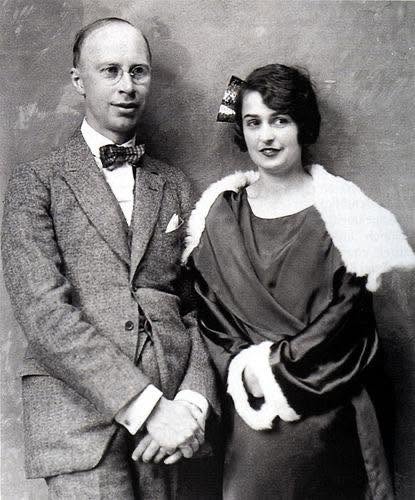
Prokofiev sought an active career and artistic stature in Paris. This he mostly achieved. His time there saw, in Paris or other European cities, the premieres of three new ballets with Diaghilev’s Ballets Russes, his Second Symphony, his Violin Concerto No. 1, his opera The Gambler, and many smaller orchestral and chamber pieces, along with the European premieres of The Love for Three Oranges and the Third Piano Concerto. Financially he was secure, if not wealthy. But frustrations arose here too, such as Stravinsky’s dominance of Parisian musical life, and the music of French modernist composers like Auric and Poulenc that he thought sterile and vapid, but which received more attention than his own.
Prokofiev never fully integrated himself into French musical culture. “Living in Paris does not make one a Parisian,” he wrote in his autobiography; but if he felt like an exile, he did not consider himself an émigré either. He expressed contempt for the Russian émigrés who vowed never to return to Soviet Russia and attempted to assimilate elsewhere. He thought of himself as Russian and maintained contact with the musical culture there, receiving regular reports about the popularity of his music among Moscow and St. Petersburg audiences. So he was receptive to invitations from the Soviet cultural leadership to visit his homeland, and he did so in 1927, 1929, and 1932, when his music was performed to great acclaim and he received major commissions like Lieutenant Kijé and Romeo and Juliet.
In 1936 Prokofiev moved back to the Soviet Union. Things looked promising; there were Initial hints that privileges would be extended to him, and his first compositions there like Peter and the Wolf and Alexander Nevsky earned official praise. But as artistic persecution by the Stalin regime intensified and focused on Prokofiev as it already had on Shostakovich, privileges were revoked and his music was censured as decadent and anti-Soviet. In time Prokofiev’s fall from favor would be devastating and irreversible. Yet after the German invasion of the U.S.S.R. in November 1941 drew the country into World War II, the Soviet government relaxed its cultural policing and emphasized patriotism and anti-Fascism. Important artists, including Prokofiev, were evacuated to places of safety where they could work undisturbed, devoting their efforts to raising morale and promoting national unity.
In Tbilisi, such a refuge, Prokofiev completed the Seventh Sonata in 1942. He had begun it in 1939, along with the Sixth and Eighth; the three of them together are called his “War Sonatas.” On January 18, 1943. Sviatoslav Richter premiered the work in Moscow. Richter later wrote, “With this work we are brutally plunged into the anxiously threatening atmosphere of a world that has lost its balance. The audience clearly grasped the spirit of the work.” Prokofiev received the Stalin Prize for the Sonata shortly after its premiere; the terror and grief cited by Richter were interpreted by the regime as defiance and resilience.
The sonata’s first movement, marked “fast and restless,” opposes two theme groups. Each group is a complex of clearly related motifs and ideas; and while the two groups’ surface qualities are distinct and different from each other, they share an underlying aura that is sinister and ominous. The opening complex is rapid, angular, loud, and harshly dissonant, with a propensity to violence; the second one is slow, brooding, menacing, and ambiguous, with an almost disembodied melody. These theme complexes appear and recede in a dramatic environment that encompasses thunderous rage and dark foreboding.
By contrast, the second movement, marked “slower and fervent,” opens with a richly harmonized, slowly unfolding melody that soars to a climax. As the music grows more animated, a restless theme emerges from the bass, quickly develops into a lament and then explodes in agitated, passionate declamations. Thunderous bells toll as if over a scene of total devastation before the opening melody returns briefly, weak and futile.
The finale is a perpetual motion of furious activity. It is relentless to the point of frenzy, but it is controlled frenzy: always firmly grounded in its key, rhythmically muscular and clear, even given its unusual pattern of 7 beats to the bar, and straightforward in its phrase structure. This polarity between wildness and order lends the music its unique energy. The pace relaxes slightly when an expressive melody pops out almost exactly halfway through the movement, but the respite is short. The madness soon resumes and builds to even greater intensity: range expands, textures are thicker and denser, volume increases, as the music races to an exhilarating conclusion.