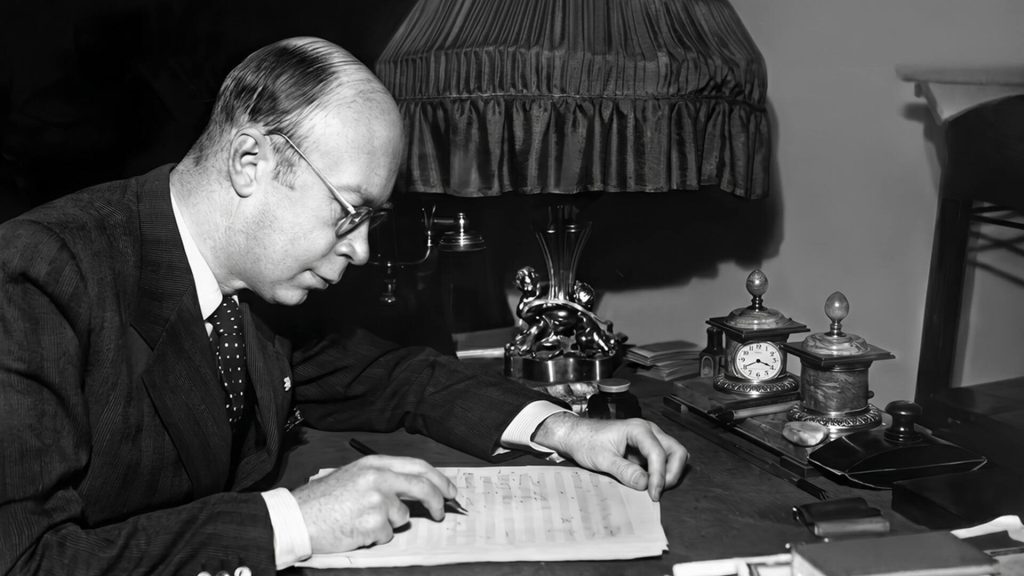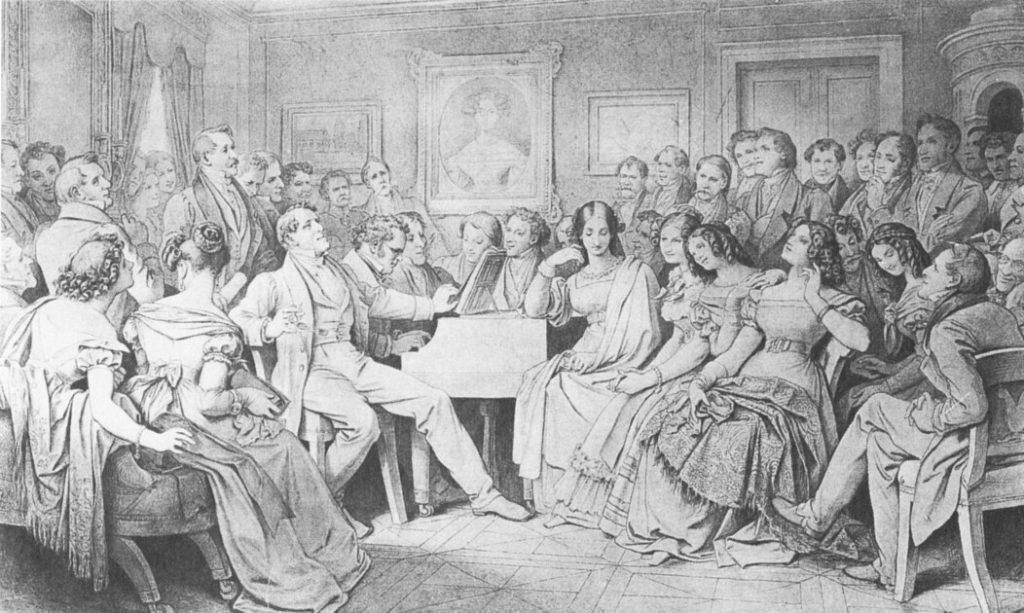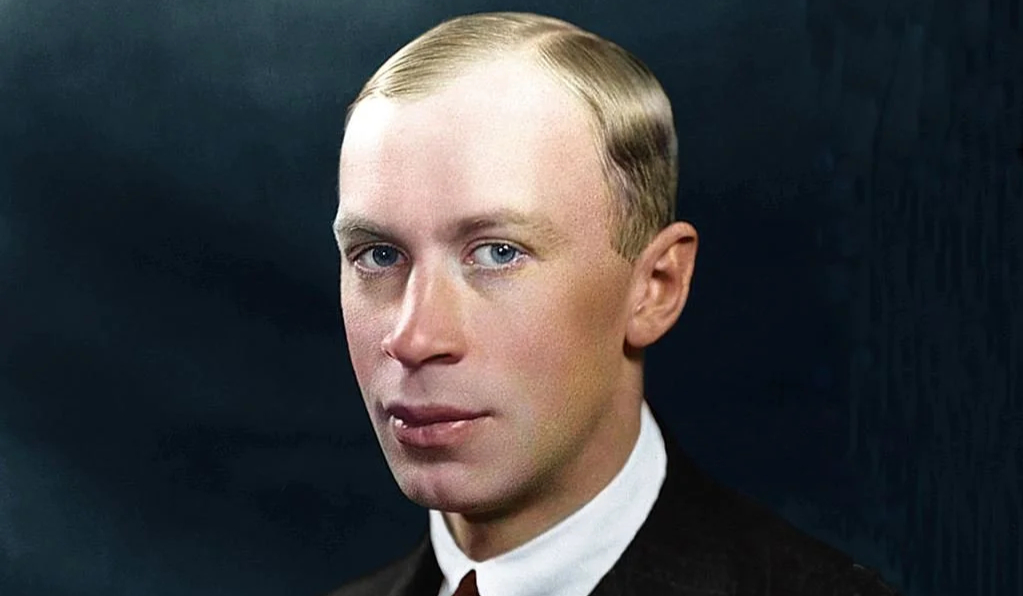

The nine piano sonatas of Sergei Prokofiev (1891-1953), which span the entire course of his creative activity from his youth up to his final year, are widely considered one of the most significant bodies of piano music composed in the twentieth century. They are monumental in their physical demands upon the pianist, dazzling in the brilliance and variety of their sound worlds, and deeply expressive of human struggle, resilience, and passion. These sonatas speak in Prokofiev’s unmistakable musical voice; they embody his evolving artistic goals but also bear the imprint of his tumultuous life and times. Thus, each sonata will be contextualized in the program notes by the personal and historical circumstances that nurtured and colored it.
September 15, 2026: Love and War
Sonata No. 1 in F Minor, Op. 1 (1907, rev. 1909)
As a rule, the publication of his first opus is a landmark for the composer, a sort of dividing line between his early work and his mature compositions. With me, it was different: the Sonata No. 1, a naïve and simple little piece, marked the end of my early period.
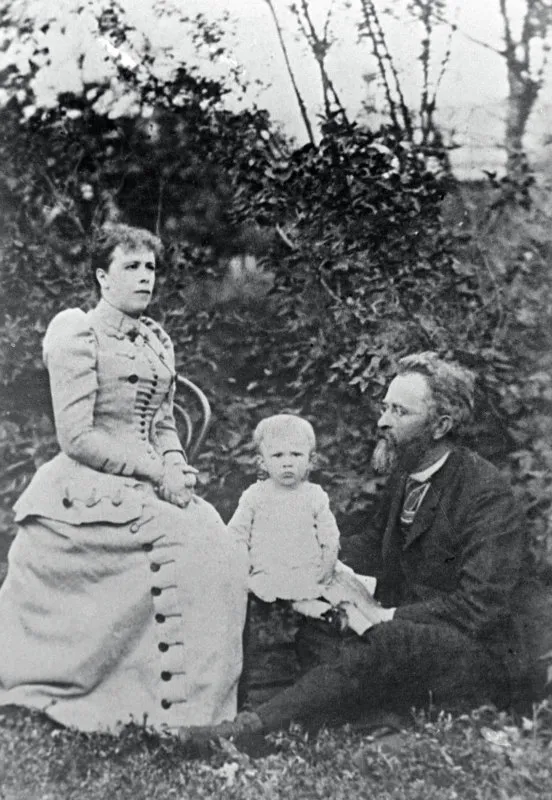
What sort of composer declares that a stylistic break and an artistic leap forward occurred in his music at the tender age of 16? The type who appeared for his entrance examination into the St. Petersburg Conservatory when he was 13, bearing a portfolio of completed works that included four operas, two sonatas, a symphony, and dozens of piano pieces – causing the venerable director of that Conservatory, Nikolai Rimsky-Korsakov, to exclaim, “Here is a pupil after my own heart!” This prodigy was Sergei Prokofiev, born April 27, 1891, whose musical gifts emerged when he was a toddler and whose creativity was lovingly and systematically fostered by well-educated parents who understood his great talent.
Growing up on the rural estate of Sontsovka (in what is now Ukraine) which his father managed, Prokofiev enjoyed a privileged, if isolated, existence. His mother, an accomplished pianist who had studied at the Moscow Conservatory, oversaw his early musical education. She began his piano lessons when he was four, introducing him to Beethoven, Chopin, and a wide range of other music, and encouraged him to experiment with and write down his musical ideas. Thus, from the beginning his pianistic and compositional abilities developed simultaneously. Inspired by opera and ballet performances he attended in Moscow with his parents, he confidently wrote his own opera, The Giant, at age nine, and performed it with his cousins for their family.
In 1902 Prokofiev’s parents met Sergei Taneyev, director of the Moscow Conservatory, who arranged for the composer/pianist Reinhold Glière to teach their son theory, piano, and instrumentation. Under Glière, the boy flourished, producing a tremendous number of compositions. Prokofiev’s mother, surmising that he might have a future in music, consulted Alexander Glazunov, director of the St. Petersburg Conservatory, about her son’s options. Glazunov, impressed, perceived Sergei’s artistic potential and urged her to send him to the Conservatory, then considered the center of Russian musical education. So in 1904, at age 13, Prokofiev moved to St. Petersburg and entered that institution.
Accustomed to individualized instruction and the freedom to explore his own ideas, Prokofiev found the Conservatory stifling. He thought the teachers dull and was frustrated by their insistence on the rules and traditions of harmony, counterpoint and form at the expense of individual creativity. Nevertheless, he completed his composition studies in 1909 and remained there until 1914 for intensive training as a concert pianist and conductor, with the aim of establishing a career as a performer of his own works. At the Conservatory, Prokofiev was surrounded by the most influential Russian composers of the era: Glazunov, Rimsky-Korsakov, Lyadov, Medtner, Scriabin, and Rachmaninov. Although their works were not part of the Conservatory’s curriculum, the atmosphere was steeped in their music and their goal of creating a characteristically Russian style. Prokofiev admired and absorbed their music even if the only unique style he sought to develop was his own.
Moreover, being in St. Petersburg afforded access to venues where Prokofiev could hear the latest musical trends and connect with leading critics and musicians. In 1908 he was invited to audition for the organizers of the Evenings of Contemporary Music, a society offering a series of new music concerts, presenting the works of European composers like Schoenberg, Debussy, Mahler, Richard Strauss and Ravel. The society also promoted local innovative talent, and under its aegis Prokofiev made his professional debut on December 31, 1908, playing his own compositions. Thereafter he performed regularly on the series. The society was an important network of support, aligning him with the avant-garde and establishing his reputation as a modernist and titan of the keyboard. His association with the society also led to opportunities beyond St. Petersburg, and on March 6, 1910, Prokofiev made his Moscow debut, performing his Sonata No. 1 in F Minor.
Opus 1 had its basis in a three-movement sonata he had composed in 1907. In 1909 he decided to revise the earlier work, feeling that it could not hold its own against pieces he had composed since. At that point he dropped the last two movements and reworked the opening one. The resulting single-movement sonata was accepted as his Opus 1 by the publisher Boris Jurgenson in 1911. The piece was dedicated to Vassily Morolyov, a veterinarian and music lover from Prokofiev’s home village.
Prokofiev’s description of this sonata as naïve and simple might seem puzzling, given its constant turbulence, driving triplet rhythms, dramatic leaps and dense textures. The poet Konstantin Balmont, a friend and admirer of Prokofiev, heard in it “hasty conversations” and “arguments.” But it could be that by simple, he meant the dominance of one emotion, a mood of youthful passion, and the obsessive repetition of a single melodic figure. And by naïve, he may have meant that its three-part structure, clearly delineated sections, and conventional opposition between major and minor in the two main themes reveal a student’s mindset, not the original thinker he strove to be but one who was obligated to adhere to the professors’ rules for composing a sonata.

The listener’s ear is guided throughout by two compositional strategies. First, Prokofiev carefully marks the beginning and end of each section through timing and sound. Slower tempos, reduced volume, lessened activity and pauses or silences function as transitions. Second is Prokofiev’s consistent use of a rising four-note melodic motif that opens each statement of the agitated main theme in the minor mode, and the second gentler theme in major. These two ideas are presented in the opening of the sonata. They are followed by two different but related themes that provide closure for this first section: a quiet melody that opens with the melodic motif reversed, falling instead of rising; and an aggressive gesture in dotted rhythm which ends with the falling four-note motif. The middle section builds tension by fragmenting and opposing the four themes, placing them in conflict with each other and building tension pianistically through loud dynamics, massive, repeated chords and sweeping gestures up and down the keyboard. Prokofiev surprises with the return of the opening melody, which he casts in a strangely subdued manner – slower, quiet, and abbreviated, as if it was drained of energy. The second, major-key theme, however, receives more emphasis in this last section. So do the two closure themes, which are longer and more dramatic as well and lead into a massive, strident coda. Thus, Prokofiev creates an end-weighted piece, first minimizing and then expanding the musical materials to build excitement and delay the climax until the final measures.
Sonata No. 2 in D Minor, Op. 14 (1912)
The cardinal virtue (or vice if you will) of my life has been my search for an original language of my own in music.
Not long after the completion of Prokofiev’s first sonata came his second, in 1912. It resembles Opus 1 in that it originated in previously composed music. Prokofiev crafted this sonata from an earlier sonatina as well as an exercise he had written in 1908 for his composition teacher Lyadov. This habit of reworking his compositions was one Prokofiev retained throughout his life. Sometimes the earlier pieces contained elements he liked which held potential for other uses in his evolving musical thinking. But if their final form pleased him and they were part of a larger work that had little chance of being performed, he routinely recycled them in more practical form rather than see them languish unheard. For example, music from his opera The Fiery Angel, which he labored on for ten years but which was never staged, was repurposed in his 3rd Symphony. Four movements from his ballet Ala and Lolly, commissioned by Diaghilev but rejected by that impresario, were recast as Scythian Suite for orchestra, which became one of his most popular works.
During his final years at the Conservatory, Prokofiev, already a sensation within the school as a performer, concentrated on his conducting and piano studies. His compositional efforts continued unabated; besides songs and many small-scale piano works, he began to write symphonic and choral music and produced his first two piano concertos.

Outside of the Conservatory his reputation as a controversial and innovative figure had grown rapidly since his debut performances in 1908 on the Evenings of Contemporary Music concerts in St. Petersburg and Moscow. In 1912, the year his Second Sonata was composed, he first appeared as soloist with orchestra in his 1st Piano Concerto, first in Moscow and then in Pavlovsk; a year later he premiered his 2nd Piano Concerto in Pavlovsk. But it took two years after his professional debut for Prokofiev to earn recognition within the Conservatory as a pianist-composer, which he felt was his true identity and the way he wanted to be perceived. In 1910 he finally received this recognition, when his Two Poems for chorus and orchestra were performed at a Conservatory concert, to his immense gratification: “My stock in the Conservatory rose rapidly, and I became a well-known figure within its walls, just as I had dreamed of.” In November of 1910 he wrote in his diary that he was “appearing in all my capacities simultaneously, as composer, conductor, and pianist.”
Perhaps because of the inspiration and energy he felt over his burgeoning career, the expressive style of 1912’s Sonata No. 2 has little in common with the earnest and obsessive outpourings of its predecessor. It is grander in scale, comprising an enigmatic Allegro, a sinister scherzo, a slow elegy, and a brilliant finale. More importantly, Prokofiev breaks with the Russian romantic sonata practice of Rachmaninov, Scriabin and Medtner. Rather than sustaining a serious emotional environment, Prokofiev switches madly among a wide range of moods, abandoning long-breathed lyricism for variety of texture, extremes of register, biting dissonance, and moments of mockery. Scriabin and Medtner, representing the “old guard,” criticized this piece as vulgar and unrefined, but champions of Prokofiev’s modernism found it original, refreshing, and colorful.
As was the case with most of Prokofiev’s piano music, the composer himself premiered his second sonata on February 5, 1914, in the Small Hall of the Moscow Conservatory. When it was published in 1913, Prokofiev dedicated it to Maximilian Schmidthof, a fellow student and close friend whose suicide in April 1913 shocked him deeply. Schmidthof was also the dedicatee of the second Piano Concerto.
The first Allegro movement is a study in character change. Prokofiev superficially follows the three-part sonata scheme: an opening section that presents two themes along with transitional and closing material, a middle section that fragments and shuffles all of these, and a closing section that puts everything back in order. Listeners are aware of these three parts because Prokofiev slows or stops the action when he moves from one to the next. But what we experience is not three sections but a constant whirlwind of contrasts, because his strategy is to present us with multiple musical personalities in close succession. The aggressive opening theme is rudely interrupted by an insistent hammered dissonance and must restart itself; but it does so with a new texture and register. A mechanical-sounding transition leads incongruently to a dreamy waltz that winds down into a sad ending punctuated by angry-sounding outbursts. The middle section begins with the waltz theme transformed, which suddenly gives way to a rapid, whimsical version of the mechanical transition from before; but that quickly turns troubled and dramatic as it slows down and moves to the low register, becoming ever more menacing. Then the opening theme returns in a new register and texture; it is followed by yet another version of the mechanical transition before the languorous waltz reappears with different accompaniment and sputters to an end. Once more the opening theme is heard but this time in a dry machine-like guise to finish this enigmatic movement.
The second movement, Scherzo, begins with a relentless rhythmic figure underpinning a short, repeated motive, with the left hand crossing over the right in a gesture that adds visual excitement while enhancing the atmosphere of aggressiveness. It is followed by a somewhat dance-like, repetitious section whose mechanical quality reminds pianist Boris Berman of “puppet music.” The return of the opening material in the low register is ominous, and it builds to a powerful close with thicker textures and harsh accents.
Russian musicologists characterize the third movement, Andante, as a “fairy tale.” Its dreamlike environment is produced by a soft, static, rocking accompaniment under a slowly-unfolding melody in its first section. This section is followed by a disorienting episode in 7/8 time; its haunting motive systematically descends over a meandering inner voice and strange, bell-like chords in the left hand. Each episode returns with its character transformed, adding to the other-worldly uncanny aura of the movement.
The Vivace finale, another study in drastic character contrast, opens with a wild tarantella whose theme bursts forth in a surge of motoric energy. The triplet accompaniment gives way to a passage of repeated descending chords that leads to a second, coquettish theme reminiscent of Prokofiev’s ballet Romeo and Juliet. A new version of the repeated chord transition closes the first section. The middle section begins with the opening theme unexpectedly transformed into a sweet and expressive song which is soon interrupted by a boisterous passage sounding straight out of the dance hall. This section grows more maniacal until it culminates in a loud, grotesque trill. Once more the tarantella, the chordal transition, and the coquettish sections return, before all three characters are combined and a brilliant cascade of arpeggios and chords brings the sonata to a dramatic close.
Sonata No. 6, Op. 82 (1935[1939]-40)
I consider it a mistake for a composer to strive for simplification. Any attempt to ‘play down’ to the listener is a subconscious underestimation of his cultural maturity and the development of his tastes; such an attempt has an element of insincerity. And music that is insincere cannot be enduring.

After the October Revolution in Russia in 1917, many artists fled the country: Stravinsky, Rachmaninov, Medtner, even Tcherepnin and Glazunov, Prokofiev’s teachers. Prokofiev too left his homeland at this time but was the only composer who would later return. His motivation appears to have been more financial than political. World War I and the revolution curtailed artistic activity in Russia; the Western Front had collapsed, and civil war raged between Bolsheviks and Cossacks. Domestic travel was dangerous and several of his concerts were cancelled. Fearing his career was stalled just as it was taking off, Prokofiev hoped to develop an artistic profile in the West. He applied for and received permission to go abroad, arriving in the U.S. in September 1918 and remaining there until 1922.
The tragic story of Prokofiev’s exile and return will be told in the notes for the remaining two programs. For now, we note that the groundwork for repatriation had been laid by the new Soviet regime in 1925, when it began inviting emigré Russian artists to visit. Prokofiev, living in Europe at the time, missed Russia and had kept abreast of musical life there through friends and relatives. He decided to investigate the opportunities a return might bring. During his three visits (in 1927, 1929, and 1932), he was fêted with performances of his works and given commissions and promises of artistic freedom. After a period of deliberation and analysis, in 1936 he finally moved back to the Soviet Union with his wife and two sons.
For a while the promises that enticed Prokofiev to return were kept. He was even allowed to travel outside the U.S.S.R. for performances. But soon, repression began and, as Prokofiev scholar Dorothea Redepenning puts it, “the trap snapped shut.” His massive cantata commemorating the October revolution was denied permission for performance as too complex, while a suite for chorus and orchestra was criticized as too simple. Endless revisions were requested in the score of the ballet Romeo and Juliet, which had been commissioned by the Bolshoi in 1935; it would not be performed until 1940. In 1938 his loss of stature was cemented. His upcoming tours to the West were cancelled and he was ordered to surrender his passport, making him ineligible to leave the Soviet Union. Further, his marriage was in tatters, and he and his wife Lina were leading separate lives.
Then at the end of the decade, Prokofiev was rejuvenated. During the summer of 1938, at a resort in Kislovodsk, he met Mira Abramovna Mendelson, an aspiring poet over 20 years his junior who introduced herself as his ardent admirer. They became friends and stayed in touch over the winter, and the following summer when Prokofiev returned alone to Kislovodsk to work, she arrived there at his request. Mira devoted herself to supporting his work and tending to his artistic needs. Their personal and creative partnership blossomed, and in 1941 Prokofiev left his family to live with Mira. Until he died, she was his loyal companion, co-author, advisor, and guardian of his well-being and work.
During these happy years Prokofiev composed the three piano sonatas (6, 7, and 8) known in the West (but not in Russia) as his “War Sonatas.” They are widely taken as Prokofiev’s responses to the horrors of World War II. But the U.S.S.R. did not enter the war until 1941, and the 6th Sonata was completed in Spring 1940. Mira Mendelson stated that the three sonatas were conceived by Prokofiev in the fall of 1939, the first and second to be “restless and stormlike” and the third “tender and dreamlike.” Their characters appear to have been set prior to 1941. Furthermore, Prokofiev’s sketches for the three works date back to 1935. We cannot say whether reports of war in Europe, Stalin’s brutal purges within the U.S.S.R., or the political repression visited on Prokofiev himself inspired the turbulence embodied in the Sixth Sonata. But the work’s dark fury is unmistakable.
The Sixth Sonata was premiered by Prokofiev in Moscow on April 8, 1940, for a live radio broadcast by the Union of Composers. Sviatoslav Richter gave the first public stage performance in Moscow on November 26, 1940. Afterwards, Dmitri Shostakovich wrote to Prokofiev, “The Sixth Sonata is magnificent. From beginning to end. I am very happy that I had the opportunity to hear it two times, and regret that it was only two times.”
The sonata opens in a fierce and disturbing manner, the jagged main theme repeatedly juxtaposing the keys of A Major and A Minor while the left hand hammers out harsh octaves. A chromatic melody snakes its way from low to high in preparation for the second thematic idea, at once song-like and calm; the clash between the two moods is deeply unsettling. As if realizing our fears, an obsessive, accented four note motif takes over, eventually underpinned by thick chords that evoke tolling bells. The middle section begins with the song theme which soon takes on a sinister character. All the themes from the first section eventually collide and battle each other; the music grows more frenzied and chaotic until it exhausts itself. After a pause the opening material reappears in a lower register, leading to an assertive and passionate version of the song-like second theme that denies any relief. Mighty bells, voices of doom, close the movement.
The second movement is a mocking, mechanical scherzo. Its jaunty theme unexpectedly leads into a boisterous melody arising from the bass, which engages in dialogue with a parody of the dance theme that floats in the high register. A pensive lyrical section follows, growing passionate before devolving into a reprise of the sarcastic and flippant opening.
The tender, wistful third movement seems to hold personal meaning for Prokofiev, who recalled in a letter to his friend Vernon Duke how he used to dance the slow Boston Waltz with his new love Mira. The repetitious, meditative nature of the middle section evokes the feeling of being lost in one’s memories. A sudden agitated outburst spoils the mood, but the waltz returns in a rich and passionate setting.
The restless finale restores the turbulence of the first movement and continues the pattern of conflict. The circular, relentless minor-key first theme is followed by a wide-ranging dance tune in C Major that contains the occasional humorous flourish. It gives way to the opening theme, which now incorporates a new melody made up of huge leaps. As it winds down, a third theme of repeated notes, violent and aggressive, takes over. The opening theme tries to reassert itself despite constant interruption, until the most disturbing event of the entire sonata intervenes: a bizarre and uncanny recall of the first movement’s opening gesture, slow and distorted rhythmically, obsessively repeating in all registers. The first theme revives itself, growling up from the bass register, and battles for dominance with the increasingly unhinged repeated-note theme. In this wild environment the dance tune emerges once more only to be wiped away by the powerful opening theme, until the motif from the first movement brings the work to a wrathful close.