Felix Mendelssohn’s String Octet is one of the most cherished pieces in the chamber music canon. It dazzles audiences with memorable moments ranging from incandescent brilliance to heartfelt melancholy and a beautiful mix of material in between. Its rich complexity belies the fact that Mendelssohn, one of classical music’s most miraculous child prodigies, wrote it while still in his teens.
Prodigies as Students

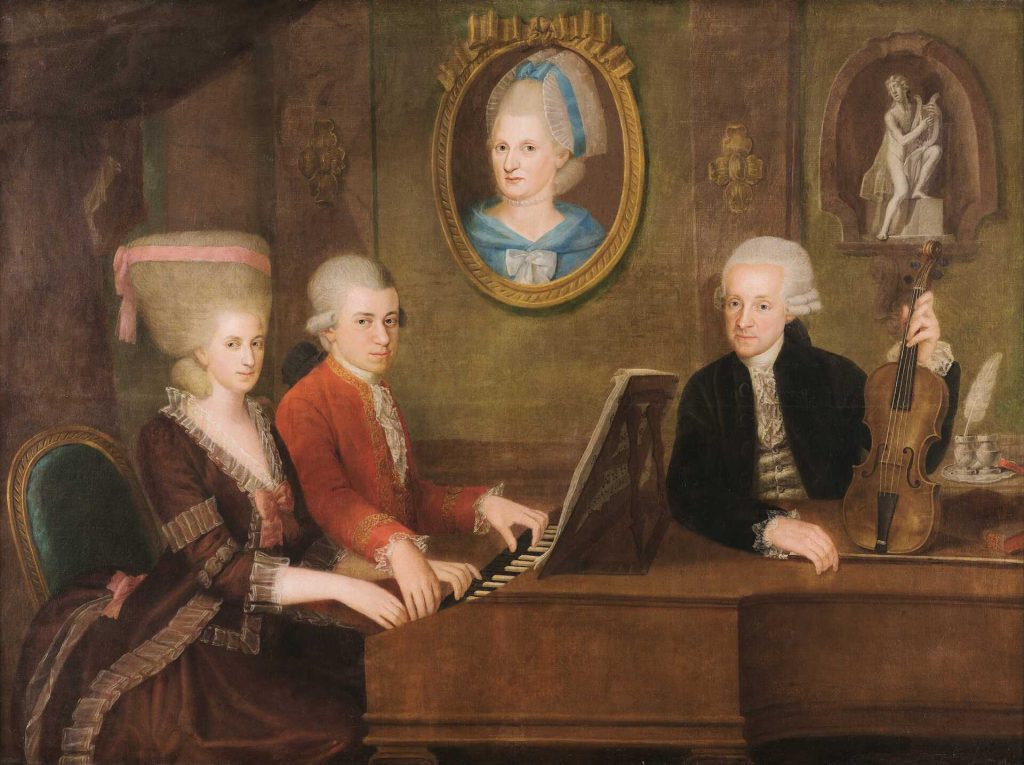
Child prodigies are, above all, profoundly gifted students. Mozart, the most celebrated of child prodigies, traveled extensively as a youngster. He absorbed and assimilated the wide range of musical styles he encountered with astonishing ease, synthesizing those he admired into his own. The results are at once incredibly inventive and perfectly appropriate for the period.
Born 53 years after Mozart, Felix Mendelssohn (1809-1847) would prove to be one of the most precocious musical prodigies of all time. Mendelssohn grew up in a well-to-do family that encouraged him to develop a number of pursuits. He painted and sketched beautifully, read Homer in the original Greek, and spoke English, French, and Italian fluently. He studied philosophy at the University of Berlin, rode horseback, and played chess and billiards enthusiastically. Of course, it was with music that Mendelssohn’s gifts shone most brightly.

As a composer, Mendelssohn was less an innovator than a polisher of the models he encountered. This wide range of influences, along with being gifted enough to turn almost anything into a musical gem, might have left Mendelssohn with less incentive to experiment. Rather than groundbreaking inventions, it is Mendelssohn’s polish and sophistication that sets him apart, even from other prodigies.
String Octet in E♭ major, Op. 20, in 1825
By the time he composed his breakout String Octet in E♭ major, Op. 20, in 1825, the 16-year-old’s technical skill in composition was beyond reproach. He had already written numerous large-scale works, including concertos, operas, and a dozen string symphonies. But with the Octet, Mendelssohn would demonstrate a new level of depth and maturity.
Mendelssohn composed his octet as a birthday present for his friend and violin teacher Eduard Rietz. Rietz was a first-rate violinist, and the Octet was to be a dazzling vehicle for violinistic virtuosity. But perhaps more importantly, the Octet gave the musicians a story to tell!
Precedent

Some music historians have argued that Mendelssohn’s Octet is without precedent in the literature. In fact, it seems almost inescapable that the very first string octet, the Double Quartet Op. 65, of Louis Spohr (1784-1859), composed in 1823 and published in 1825, would have served as a partial model.
Spohr and Mendelssohn were on friendly terms, and it seems an impossible coincidence that the younger composer would have independently embarked on a piece utilizing the same, unusual instrumentation as Spohr’s Double Quartet Op. 65, in the same year that Spohr’s Op. 65 was published. There is even material in the first movement of the Mendelssohn Octet similar enough to the closing D major cadence of the first movement of the Spohr to be considered a quote.
The Models
But the Mendelssohn Octet pays tribute to other important models beyond Spohr’s. Earlier large-ensemble chamber music works had been written for mixed winds and strings, following the serenade form. A standout is the Schubert Octet, where Schubert’s introduction of the cyclic form turns the piece into a kind of deep musical storytelling that easily transcends the lightheartedness of Beethoven’s Septet after which it was modeled. Earlier versions of the cyclic technique can be observed in Mozart’s Fantasia for piano K. 475, and at the end of Haydn’s Symphony No. 31, but the use of cyclic form in chamber music appears to have been pioneered by Beethoven. Picking up on the models before him, Mendelssohn used the cyclic form to great effect in the Octet: in the Finale, the return of melodic material from earlier movements creates a cohesive narrative and a deeply satisfying sense of closure as the work concludes, often with the audience on their feet! Such a rich and evolved artistic concept seems utterly unimaginable for a then-16-year-old, but Mendelssohn executes it with glistening perfection.
Mendelssohn’s Octet marked an important turning point for the young composer, both in terms of his development as a composer and public reception. Robert Schumann praised the Octet for its “consummate perfection.” Much later, British musicologist John Horton said “…not even Mozart or Schubert accomplished at the age of 16 anything quite so accomplished as this major work of chamber music.” The piece is compelling enough to have created a standard by which Mendelssohn’s later works were sometimes measured unfavorably by an unforgiving public, fueled by over-eager critics.
Few Descendants
Despite the piece’s overwhelming popularity, Mendelssohn’s Octet has spawned relatively few subsequent string octets. Most notably, octets by George Enescu (1881-1955), Max Bruch (1838-1920), and Dmitri Shostakovich (1906-1975) are occasionally heard on chamber music programs.

Shostakovich’s Two Pieces for String Octet, Op. 11, is a somewhat enigmatic work. Begun in 1924 as a suite in five movements for double string quartet, Shostakovich set the piece aside for some months. On returning to it, he decided to radically reduce its scope. The resulting two movements are quintessential early Shostakovich: biting, modern, rhythmic, lyrical, and relentless. It remains Shostakovich’s strongest piece of chamber music written before the Cello Sonata of 1934.
Composed in 2025, John Novacek’s dazzlingly virtuoso Music for 8 explores the possibilities of a string octet in ways that previous composers could not have imagined. With its combination of jazzy and bluesy syncopations and dizzying, rapid handoffs across the ensemble, Music for 8 has already gained considerable traction with performers and audiences. But the influence of the Mendelssohn Octet as a model chamber music work, beloved both for its quality as a composition and for its power to thrill audiences, is inescapable in all that followed.
A treat is in store for Guarneri Hall audiences when NEXUS Chamber Music takes on the Mendelssohn Octet, Shostakovich’s Two Pieces for String Octet, Op. 11, and John Novacek’s Music for 8 at the NEXUS Chamber Music Festival on August 12-14, 2026.